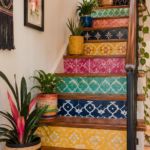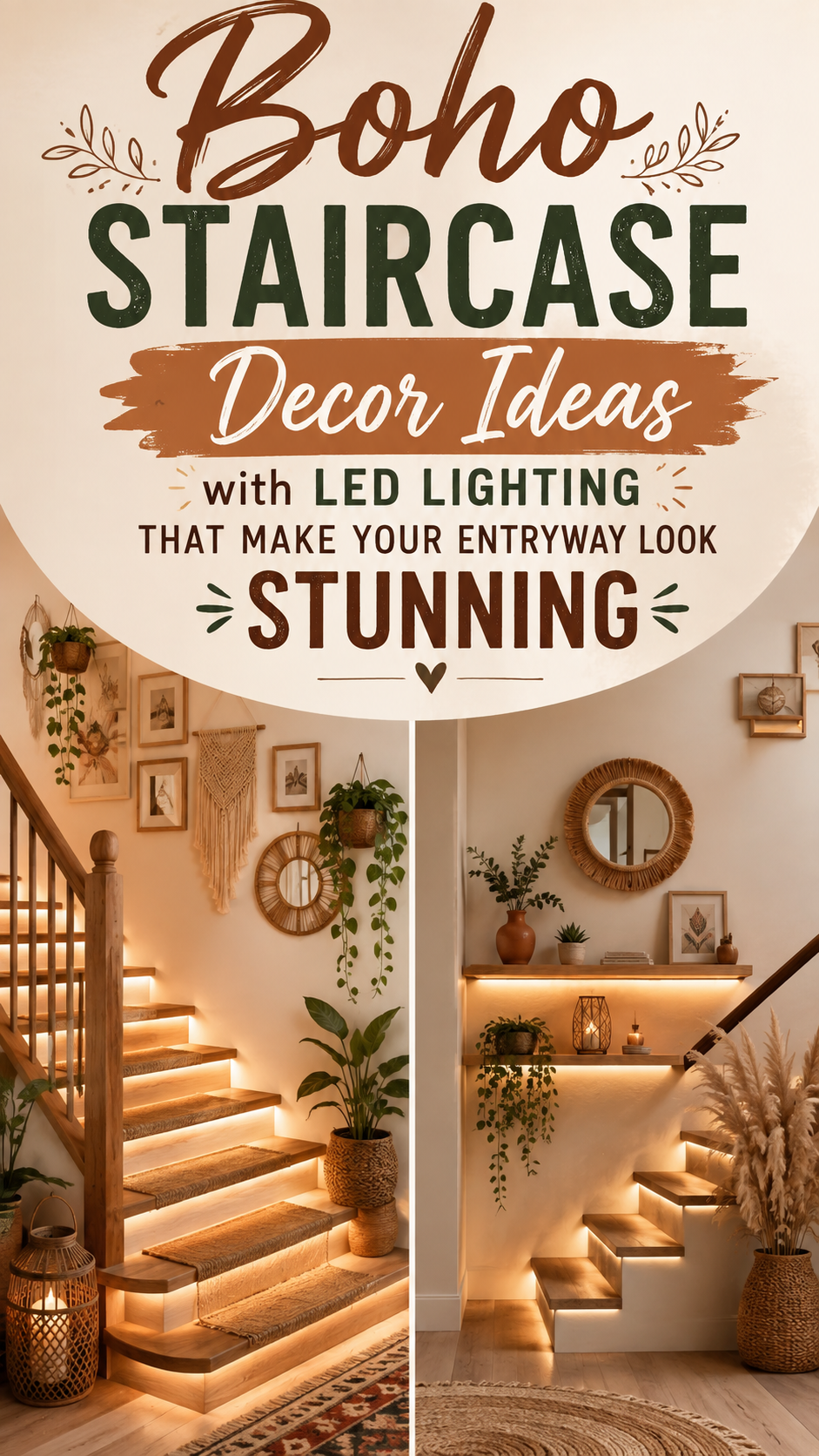
Your staircase sees more daily traffic than almost any other spot in your home, yet it’s usually the last thing anyone styles. That’s a missed opportunity. A boho staircase warmed up with the right LED lighting turns a plain pass-through into the first thing guests notice when they walk in.
This isn’t about hanging a string of fairy lights and calling it done. It’s about layering warmth, texture, and light so the whole entryway feels intentional. Below, you’ll find a full room-by-room approach to pulling it off, from the color palette to the exact spots where LED strips make the biggest visual difference.
Why Boho Staircases Work So Well
Boho design thrives on texture, not perfection. Staircases are architectural by nature, so they already have strong lines. Softening those lines with rattan, macramé, and woven textiles creates a natural contrast that reads as curated rather than cluttered.
LED lighting solves the staircase’s biggest design problem. Most staircases rely on a single overhead fixture that flattens everything underneath it. Warm LED strips tucked under handrails or along risers add depth and shadow play that overhead lighting simply can’t.
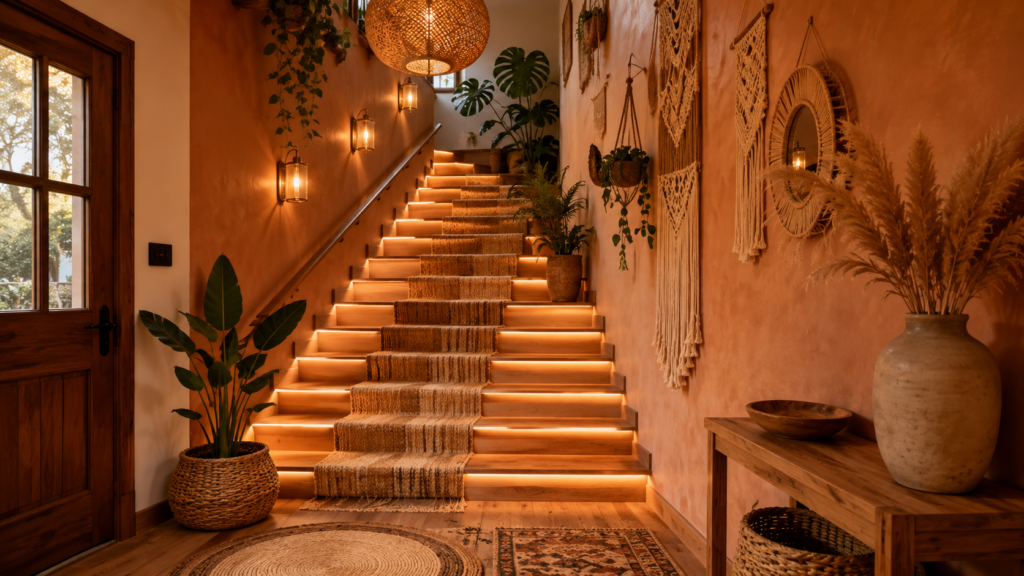
The combination photographs beautifully. Boho textures catch warm light in a way that minimalist or industrial finishes don’t. Rattan pendant shades, woven runners, and macramé wall hangings all pick up a golden glow from 2700K–3000K LED strips, which is part of why this pairing performs so well on Pinterest. <div class=”designer-note”> <strong>Designer Note:</strong> If your staircase gets natural light during the day, plan your LED placement around the evening hours. The goal is a space that looks good in daylight and transforms after sunset, not one that only works under artificial light. </div>
Colour Palette
Boho staircases lean on warm neutrals as the base, with one or two saturated accent colors layered in through textiles and greenery.
| Palette Element | Color Direction | Where to Use It |
|---|---|---|
| Base | Warm white, sand, terracotta | Walls, stair risers |
| Wood tones | Honey oak, walnut, rattan | Handrails, pendant fixtures |
| Accent | Rust, ochre, deep teal | Runner rugs, wall hangings |
| Metal | Brass, aged bronze | Sconces, stair rods |
| Light temperature | 2700K–3000K warm white | LED strips, pendant bulbs |
A simple 60-30-10 formula keeps the palette from feeling busy. Sixty percent warm neutral (walls and treads), thirty percent wood and rattan tones, and ten percent saturated accent color through textiles or plants. This ratio is why boho spaces feel layered instead of chaotic — every color has a defined job.
Stick to warm-temperature LEDs throughout. Cool white (4000K+) strips clash with rattan and wood tones and can make a boho staircase look sterile instead of inviting. If you want a color-changing option for occasional use, choose an RGBW strip that defaults to warm white rather than a pure RGB strip.
Where to Place LED Lighting on a Staircase
Under-tread lighting creates the biggest visual impact for the effort involved. Running a warm LED strip along the underside of each tread produces a soft glow that outlines every step without needing to touch your existing fixtures. This works especially well on open-riser or floating staircases, where light spills through to the wall behind.
Handrail lighting doubles as a safety feature. A slim LED strip recessed into the underside of a wooden handrail lights the path down without glaring into anyone’s eyes. This is a smart choice for stairwells that stay dim during early morning or late evening hours.
Wall-mounted uplighting highlights texture instead of flatness. Small brass or bronze sconces spaced every three to four steps cast light both up and down the wall, which draws attention to a gallery wall, woven hanging, or textured plaster finish running alongside the stairs.
Baseboard strip lighting works for landings and transitions. Along a landing or the base of the staircase, a thin LED strip hidden behind the baseboard trim adds a subtle glow without any visible hardware, keeping the boho aesthetic uncluttered. <div class=”quick-win”> <strong>Quick Win:</strong> Start with a single under-tread LED strip kit with a built-in dimmer. It’s the lowest-cost, lowest-commitment way to test whether you like the effect before wiring anything more permanent. </div>
Furniture and Styling Elements
A rattan pendant at the top of the stairwell anchors the whole space. Since staircases are often multi-story, a single statement pendant hung from the highest point gives the eye somewhere to land and ties the upper and lower levels together visually.
Woven stair runners soften hard surfaces underfoot. A jute or wool-blend runner in a neutral or striped pattern adds texture at foot level, which balances out the wood and metal elements higher up the wall.
A console table at the base of the stairs earns its keep. Rattan or reclaimed wood consoles work well here, giving you a spot to layer a table lamp, a woven basket, and a trailing plant without crowding the walkway.
Layered wall textures fill vertical space. Macramé hangings, woven wall baskets, and framed botanical prints mixed together along the stair wall keep the eye moving upward, which makes narrow stairwells feel taller rather than cramped.
Layout Tips for Different Staircase Types
Straight staircases benefit from a repeating rhythm. Space sconces or wall art at even intervals every two to three steps so the eye reads a pattern rather than a random scatter.
Spiral staircases need lighting that follows the curve. A continuous LED strip along the inner handrail works better here than individual fixtures, since it wraps naturally with the shape instead of creating awkward gaps.
L-shaped or split staircases should treat the landing as its own moment. Add a small accent piece, like a woven pouf or a floor lantern, on the landing itself so the transition between flights feels styled rather than empty.
Small Space Adaptations
Skip bulky furniture entirely in narrow stairwells. A slim wall-mounted shelf holding two or three curated objects does more for a tight space than a console table ever could.
Use vertical striping to add height. A runner with a bold vertical pattern, paired with tall, narrow wall art, draws the eye upward and makes low-ceilinged stairwells feel more open.
Choose slim LED profiles over bulky fixtures. Ultra-thin strip lights (under 10mm wide) tuck into tight gaps along treads or trim without eating into an already narrow walkway.
Mirror placement multiplies light in dark stairwells. A single round rattan-framed mirror positioned to catch the LED glow bounces warm light back into the space, which matters most in stairwells with no natural light source.
Budget vs. Luxury Comparison
| Element | Budget Approach | Luxury Approach |
|---|---|---|
| LED lighting | Plug-in adhesive strip kit, $25–$50 | Hardwired, dimmable strip with smart controller, $200–$400 |
| Runner | Machine-woven jute runner, $60–$120 | Hand-knotted wool runner, custom-cut, $400–$900 |
| Pendant light | Rattan pendant from a big-box retailer, $80–$150 | Handwoven rattan or artisan-made fixture, $300–$700 |
| Wall decor | DIY macramé or thrifted prints, $20–$60 | Curated gallery wall with framed original art, $500+ |
| Console table | Ready-to-assemble rattan console, $150–$250 | Solid wood or vintage rattan piece, $600–$1,200 |
| Total estimated range | $335–$630 | $2,000–$3,200+ |
The lighting upgrade delivers the most visible return regardless of budget. Even the plug-in LED strip option transforms how the staircase reads at night, which makes it the first place to spend money if you’re working with a tight budget.
Styling Mistakes to Avoid
Mixing warm and cool light temperatures in the same stairwell. Combining a 3000K LED strip with a 5000K overhead bulb creates a visual clash that undercuts the cozy boho effect you’re going for.
Overcrowding the stair wall with too many hanging pieces. Boho design uses layering, but layering still needs breathing room. Leave gaps between wall pieces so the eye has somewhere to rest.
Choosing a runner that’s too narrow for the tread. A runner should leave two to three inches of exposed wood or tile on either side. Anything narrower looks like an afterthought rather than a design choice.
Skipping a dimmer switch on the LED strips. Full brightness works for daytime visibility, but a fixed-brightness strip loses the ambient effect that makes boho lighting feel intentional at night.
Ignoring stair safety codes when adding lighting. Always check local electrical codes before running wiring near stair treads, and use battery or plug-in options if hardwiring isn’t an option in your space.
DIY Improvements
Wrap the stair rail in natural jute rope for texture. This is a weekend project that adds tactile warmth to a plain metal or painted wood railing for under $30.
Build a simple LED channel using aluminum trim. Aluminum LED channels are inexpensive, snap onto tread edges with adhesive backing, and diffuse the light more evenly than an exposed strip.
Refresh a thrifted console with a rattan cane panel. Adding cane webbing to plain cabinet doors is a low-cost way to bring boho texture into a piece of furniture you already own.
Hand-dye a plain runner for a custom accent color. A natural fiber runner takes fabric dye well, letting you match the ten-percent accent color in your palette without a custom order. <div class=”maintenance-note”> <strong>Maintenance Note:</strong> Vacuum stair runners weekly along high-traffic staircases, and check LED strip adhesive every few months in humid climates, since heat and moisture can loosen the backing over time. </div>
Style Variations Within Boho
Coastal Boho leans into bleached wood tones, white-washed risers, and natural fiber textures with minimal color saturation.
Desert Boho pulls from terracotta, rust, and sand tones with cactus or dried pampas grass as the greenery choice instead of trailing plants.
Global Boho mixes patterned textiles from multiple cultures, layering Moroccan-style runners with African mudcloth pillows and Turkish-inspired lanterns.
Modern Boho strips back the pattern mixing and keeps the palette closer to neutral, letting the LED lighting and one or two statement pieces do most of the visual work.
FAQ
Do LED strip lights damage stair treads? No, as long as you use a low-heat LED strip with proper adhesive backing or a mounting channel. Avoid direct adhesive on unfinished or painted wood that hasn’t fully cured.
What color temperature works best for a boho staircase? Warm white in the 2700K–3000K range complements rattan, wood, and brass finishes far better than cool white or daylight-temperature bulbs.
Can I add LED lighting to a staircase without hiring an electrician? Yes, for plug-in or battery-powered strip kits. Hardwired installations tied into your home’s electrical system should go through a licensed electrician, especially near stair treads.
How do I keep a boho staircase from looking cluttered? Stick to the 60-30-10 color formula, leave visible gaps between wall decor pieces, and choose one statement lighting fixture instead of several competing ones.
Is a runner necessary for a boho staircase look? It’s not required, but a runner adds the textural layer that makes bare wood or tile stairs feel finished. If you skip it, compensate with a bolder handrail texture or wall treatment.
A staircase you actually enjoy walking past changes how the whole entryway feels, one warm strip of light at a time.