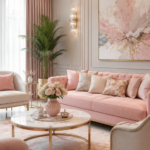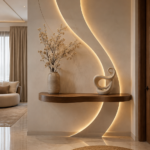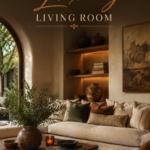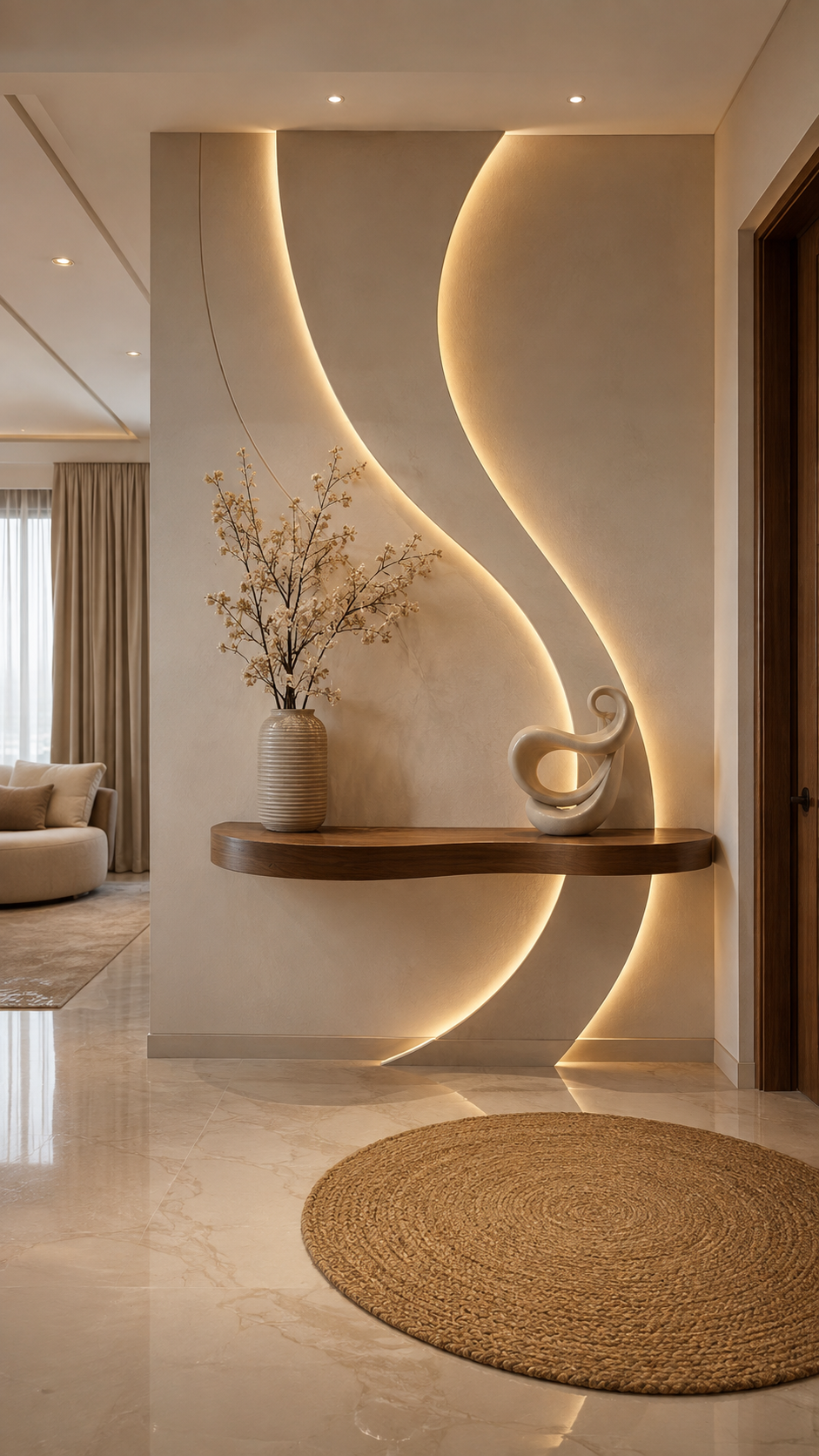
Curves are quietly taking over luxury interiors. Where sharp corners once ruled every living room and hallway, soft, sculptural lines are now the signature of high-end design. If you’ve been eyeing that arched mirror or wondering how a curved shelf could transform a blank wall, this guide breaks down exactly how to do it right.
Why This Style Works
Curved wall decor softens a room without making it feel less sophisticated. It’s the design equivalent of a well-tailored jacket: structured, but never stiff.
The psychology is simple. Curves read as organic and calming to the human eye, while straight lines and hard angles read as formal and rigid. Pair a curved mirror or sculptural panel with an otherwise minimalist room, and the space instantly feels warmer.
Luxury brands have leaned into this for years. Think of the arched doorways in boutique hotels, the rounded console tables in high-end showrooms, or the wavy plaster finishes trending across designer portfolios. Curved wall decor brings that same elevated energy home, without a full renovation.
It also breaks up visual monotony. A room full of rectangular frames and square shelving can start to feel like a grid. One curved piece — a mirror, an arch shelf, a sculptural wall panel — acts as a focal point that draws the eye and gives the space rhythm.
There’s also a practical side to the appeal. Curved decor tends to photograph beautifully, which is part of why it has become such a fixture on design mood boards and Pinterest boards alike. The soft shadow lines a curved piece casts change throughout the day, giving a single wall multiple looks depending on the light.
It signals intention. Straight-edged furniture and frames are the default — they’re what most retailers stock, and what most rentals arrive with. Choosing a curved piece instead tells a visitor that the space was considered, not just furnished.
Curves also soften architectural flaws. An oddly proportioned wall, a low ceiling, or an awkward nook often reads better with a rounded piece breaking up the hard lines than with another rectangular frame drawing attention to the shape of the room itself.
Designer Note: The goal isn’t to curve everything. One or two intentional curved elements against a backdrop of straight lines creates the most striking contrast — too many curves and the room loses its anchor.
Colour Palette
Curved decor pieces tend to work best against a restrained palette, since the shape itself is already doing a lot of visual work.
Use the 70/20/10 ratio as your starting point:
| Ratio | Role | Suggested Tones |
|---|---|---|
| 70% | Dominant wall/base color | Warm white, soft plaster beige, greige |
| 20% | Secondary tone | Terracotta, sage, walnut brown |
| 10% | Accent | Brushed gold, aged brass, matte black |
Warm neutrals let curves shine. A plaster-toned or warm white wall gives a curved mirror or arch shelf room to cast soft shadows, which is part of what makes the style feel luxurious in photos and in person.
Metallics matter more here than in flat wall decor. Brushed gold or aged brass hardware on a curved piece catches light differently throughout the day, adding a subtle shimmer that flat, matte pieces don’t offer.
Avoid high-contrast palettes. Stark black-on-white pairings can make curved decor look more like a bold statement piece than an integrated design element — which works in some spaces, but isn’t the softer luxury look most homeowners are after.
Consider undertone consistency across the room. A curved mirror with warm brass detailing will feel slightly off against a cool-toned gray wall. Matching the undertone of your wall color to the metal or wood finish of the curved piece keeps the whole vignette feeling cohesive rather than assembled from mismatched pieces.
Deeper, moodier palettes work too — with adjustments. For a more dramatic take, a deep terracotta, olive, or charcoal wall can showcase a curved piece beautifully, provided the accent metal (often brass or warm bronze) stays consistent with the 10% ratio rule so it doesn’t get lost against the darker base.
Furniture, Lighting & Layout
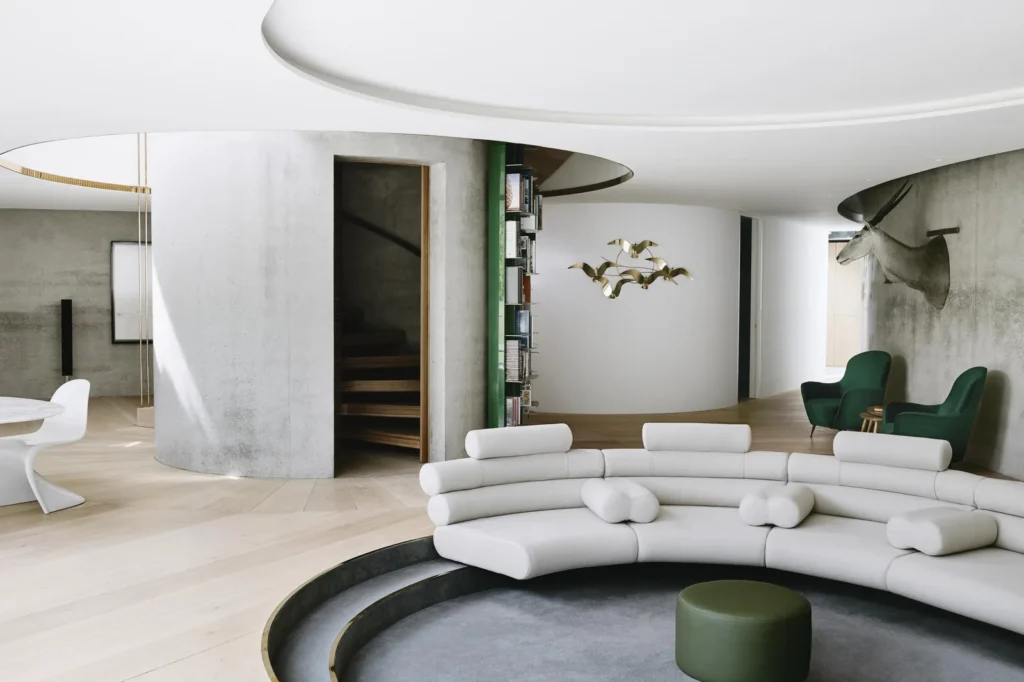
Furniture should echo the curve, not compete with it. A curved wall mirror above a straight-edged console can work, but placing it above a rounded or kidney-shaped console ties the whole vignette together.
Lighting is where curved decor earns its “luxury” label. Uplighting or a single warm-toned sconce placed beside a curved wall shelf casts a soft shadow along its edge, emphasizing the shape instead of flattening it under overhead light.
- Wall-mounted picture lights above curved mirrors
- Warm LED strip lighting behind arched shelving for a glow effect
- A single statement sconce with a curved arm to mirror the wall piece
Layout follows the “breathing room” rule. Curved pieces need more surrounding negative space than angular ones to read as intentional rather than crowded. Leave at least 8–12 inches of clear wall around a curved mirror or shelf before introducing another piece.
Quick Win: If you only change one thing, swap a flat-edged mirror for an arched one above your entryway console. It’s one of the fastest ways to signal an upgraded, designer-considered space.
Pair curved wall pieces with at least one curved textile. A rounded jute rug, a curved-back accent chair, or a scalloped throw pillow beneath a curved wall shelf helps the shape feel intentional rather than isolated to a single object on the wall.
Consider the wall’s sightline from the room’s main seating area. Curved decor placed where it’s viewed head-on, rather than at an angle, reads more clearly. Walk the room and sit in your usual spots before finalizing placement.
Group curved shelving in odd numbers when layering. Two or three arch-shaped shelves at slightly different heights, rather than one large one, can create a gallery-style moment that still respects the “one dominant shape” rule since they’re all working from the same curve.
Small Space Adaptations
Curved decor is especially forgiving in tight spaces, since rounded edges don’t create the harsh sightlines that rectangular pieces do in a small room.
Go vertical with arched pieces. An elongated arch mirror draws the eye upward, making low ceilings feel taller without adding floor clutter.
Choose one hero piece instead of a gallery. In a small entryway or hallway, a single curved mirror or wall sculpture does more visual work than a cluster of smaller frames, which can feel busy in limited square footage.
Curved floating shelves double as storage and softness. In a small bedroom or reading nook, a single arch-shaped shelf holds books or décor while avoiding the boxy look of a traditional shelving unit.
Mirrors amplify light in tight rooms. A curved mirror reflects light at slightly different angles than a flat one, which can make a small room feel a touch brighter and less confined.
Use curves to soften a corner instead of filling a wall. In tight apartments, a curved corner shelf or a rounded accent light tucked into an underused corner can add character without eating into already-limited wall space.
Keep the palette light in compact rooms. Small spaces styled with curved decor tend to feel most spacious when the curved piece itself is in a light wood tone or a pale plaster finish, rather than a dark, heavy material that can visually shrink the room.
Budget vs. Luxury
| Element | Budget-Friendly Option | Luxury Alternative |
|---|---|---|
| Wall mirror | Arched mirror, basic metal frame ($40–$80) | Hand-forged brass arch mirror ($300–$600+) |
| Wall shelf | Curved MDF floating shelf ($25–$50) | Solid walnut arch shelf, custom-cut ($200–$400) |
| Wall art | Printed abstract curve art ($30–$60) | Original sculptural wall panel ($350–$900+) |
| Lighting | Plug-in curved sconce ($35–$70) | Hardwired brass arm sconce, designer brand ($150–$350) |
| Finish | Peel-and-stick arch decal accent ($15–$30) | Hand-applied curved plaster niche ($500+ with labor) |
You don’t need every item from the luxury column. One higher-end curved piece — often the mirror or the lighting — paired with budget-friendly supporting pieces still reads as an elevated, considered space.
Styling Mistakes to Avoid
Mixing too many curve shapes. An arched mirror, a circular shelf, and a wavy console in the same sightline can start to feel chaotic rather than curated. Pick one dominant curve shape per wall.
Ignoring scale. A small curved mirror on a large, empty wall looks lost. Curved pieces generally need to be slightly larger than their flat-edged equivalents to hold the same visual weight.
Skipping the shadow. Curved decor loses most of its impact under flat, overhead lighting. Without a side light source, the shape reads flat instead of dimensional.
Forcing curves into a strongly angular room. In spaces with heavy exposed beams or industrial edges, curved decor can look like an afterthought unless it’s paired with at least one other soft element, like a rounded rug or upholstered chair.
Choosing cheap-looking materials for a hero piece. Because curved decor tends to be a focal point, a flimsy plastic or resin arch mirror stands out for the wrong reasons in a way a similarly budget flat frame wouldn’t. If you’re only investing in one higher-quality piece in the room, this is usually the one worth it.
DIY Improvements
Create a curved plaster niche effect. Using a pre-formed foam arch panel and a coat of tinted limewash paint, you can mimic the look of a built-in plaster niche for a fraction of the cost of an actual renovation.
Build a simple arch shelf. A curved plywood shelf, sanded and stained, mounted with hidden brackets, gives the look of a custom piece without a custom price tag.
Reframe an existing flat mirror. Adding a curved wooden or plaster surround to a plain rectangular mirror can transform it into an arch-style statement piece over a weekend.
Paint an arch accent directly on the wall. A soft, hand-painted arch in a contrasting warm tone behind a bed or console creates the illusion of architectural curvature with just paint and painter’s tape.
Wrap an existing shelf bracket in curved trim. Adding a thin strip of flexible wood or plaster molding along the front edge of a straight shelf can visually round off its silhouette without replacing the whole piece.
Upgrade hardware for a cohesive curved theme. Swapping straight cabinet or shelf pulls for curved, arched, or ring-style hardware nearby ties smaller design details back to the larger curved wall feature, reinforcing the theme throughout the room rather than isolating it to one spot.
Style Variations
Modern Luxury: Brushed brass curved mirrors, minimal curved shelving, warm white walls with a single sculptural accent.
Japandi: Curved wood elements paired with matte black or walnut tones, low-profile arch shelving, and soft diffused lighting.
Old-World European: Hand-applied plaster arches, aged brass sconces, and curved console tables with carved detailing.
Coastal Luxury: Whitewashed curved wood pieces, rattan-framed arch mirrors, and soft rounded lighting fixtures in warm sand tones.
Contemporary Glam: Polished brass arch mirrors, curved acrylic shelving, and metallic accent lighting for a higher-shine take on the trend that suits evening-lit living and dining spaces.
Each of these directions uses the same core principle — one dominant curved shape, a restrained palette, and thoughtful lighting — just filtered through a different material and finish story.
FAQ
Does curved wall decor work in a rental? Yes. Removable arch decals, freestanding curved mirrors, and lightweight curved shelves with adhesive-friendly mounts all deliver the look without permanent changes.
How many curved pieces should one room have? Generally one to two per wall, with a maximum of two to three focal curved pieces per room to avoid visual overload.
Is curved wall decor a passing trend? Curves have appeared in design cycles for decades, from Art Deco arches to mid-century curved furniture, which suggests staying power rather than a short-lived moment.
What’s the easiest starting point for a beginner? An arched wall mirror is the lowest-effort, highest-impact place to start, since it requires no construction and works in nearly any room style.
Can curved wall decor work with a mostly minimalist space? Yes, and it often works especially well there. In a pared-back room, a single curved piece has room to stand out as the intended focal point rather than competing with other decor.
Does curved decor suit every room, or just living spaces? Bedrooms, hallways, entryways, and even bathrooms all take well to curved decor, particularly arched mirrors, which are practical as well as decorative in those settings.
How do I keep curved decor from looking too trend-driven? Choosing natural materials like solid wood, brass, or hand-applied plaster over acrylic or trend-specific novelty shapes helps a curved piece feel more like a lasting design choice than a passing moment.
There’s something quietly confident about a curve on a wall full of straight lines — it doesn’t ask for attention, it just holds it.