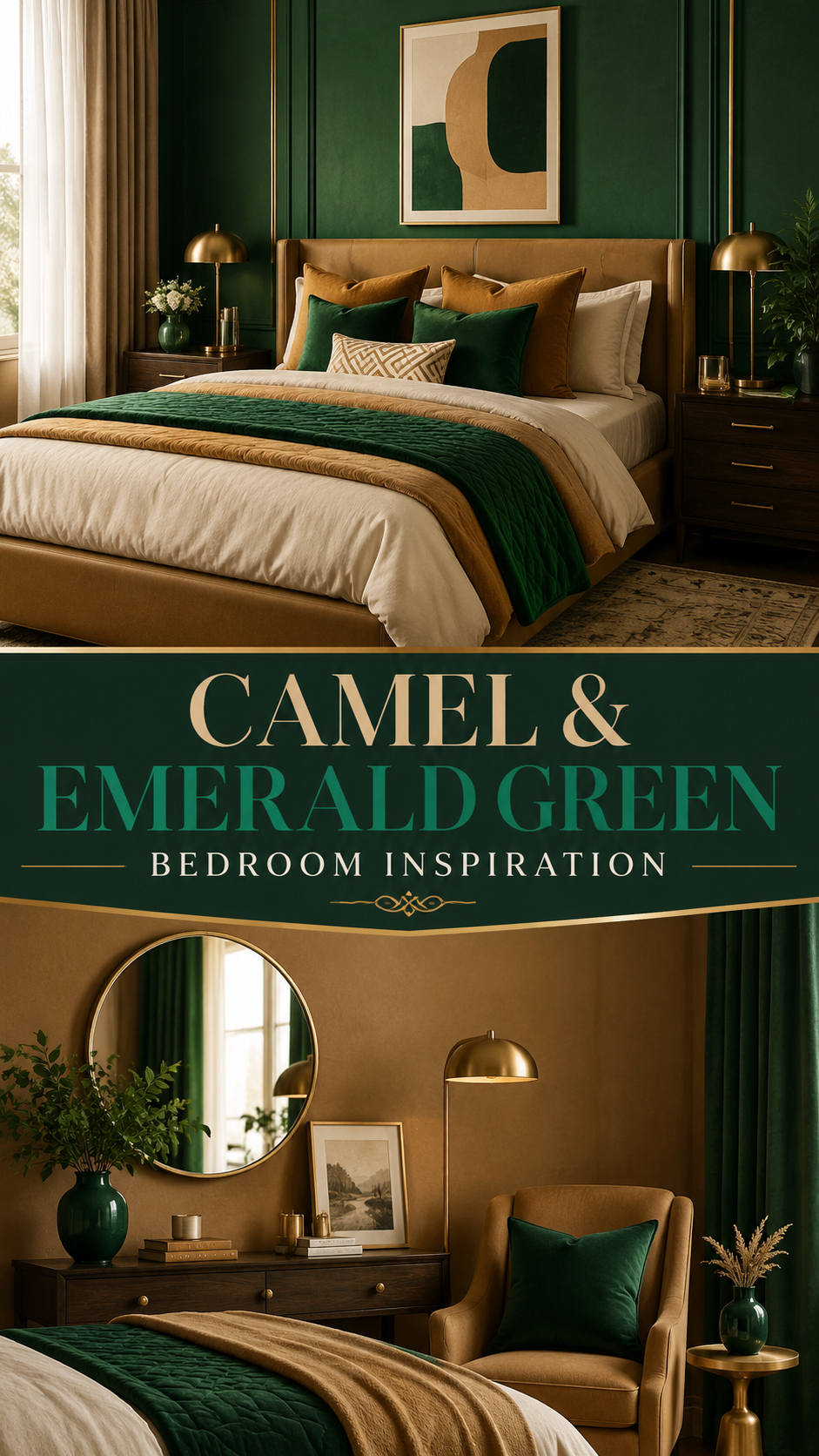
There’s a reason camel and emerald green keeps showing up in the bedrooms of people who actually care about how a room feels, not just how it photographs. Camel brings warmth and softness. Emerald green brings depth and a little bit of drama. Put them together and you get a bedroom that feels expensive without trying too hard.
This pairing works because it’s built on contrast that doesn’t fight. Camel is a neutral with a golden undertone, so it never reads cold. Emerald is a jewel tone, but it’s grounded enough to feel liveable rather than theatrical. Neither colour asks to be the only one in the room.
Below is a full walkthrough of how to build this palette into a bedroom, room by room, budget by budget, mistake by mistake.
Why This Style Works
Camel and emerald share the same emotional register. Both colours are associated with warmth, richness, and a sense of being “collected” over time rather than bought all at once. That’s part of why this combination reads as timeless instead of trendy.
The contrast is balanced, not jarring. Camel sits on the warm, muted end of the spectrum. Emerald sits on the cool, saturated end. When you place them side by side, each one makes the other look more intentional. A plain beige room can feel unfinished. A plain emerald room can feel heavy. Together, they correct each other.
It flatters natural light and lamp light equally. Camel reflects warm light beautifully, which means this palette holds up in a north-facing bedroom just as well as a sun-drenched one. Emerald deepens under lamp light in the evening, giving the room a completely different, cosier mood after dark.
It works across design styles. This isn’t a palette locked into one aesthetic. It shows up in Art Deco interiors, in modern luxury bedrooms, in traditional English-style rooms, and in warm minimalist spaces. You can dial the styling toward any of those directions using the same two base colours.
Colour Palette: How to Split the Ratio
The most common mistake with a two-colour palette like this is treating it as 50/50. It almost never should be. Camel needs to lead as the base, with emerald layered in as the depth colour.
The 60-30-10 formula works well here:
| Percentage | Role | Where to use it |
|---|---|---|
| 60% | Camel (base) | Walls, large upholstery, bedding foundation, rugs |
| 30% | Emerald green (depth) | Headboard, accent wall, curtains, or a statement chair |
| 10% | Accent metal or neutral | Brass, aged gold, warm black, or cream trim |
If you want a bolder, more saturated room, you can flip toward a 50-40-10 split, letting emerald take a bigger share through a full accent wall and heavier textiles. Just keep camel as the anchor so the room still feels calm enough to sleep in.
Undertone matching matters more than shade matching. Camel comes in cooler taupe-leaning versions and warmer honey-leaning versions. Emerald comes in bluer, more jewel-toned versions and yellower, more forest-adjacent versions. Pair a warm camel with a slightly warmer emerald, or a cooler camel with a bluer emerald. Mixing warm camel with cool-toned emerald can make both colours look slightly off.
Furniture, Lighting, and Layout
Furniture Choices
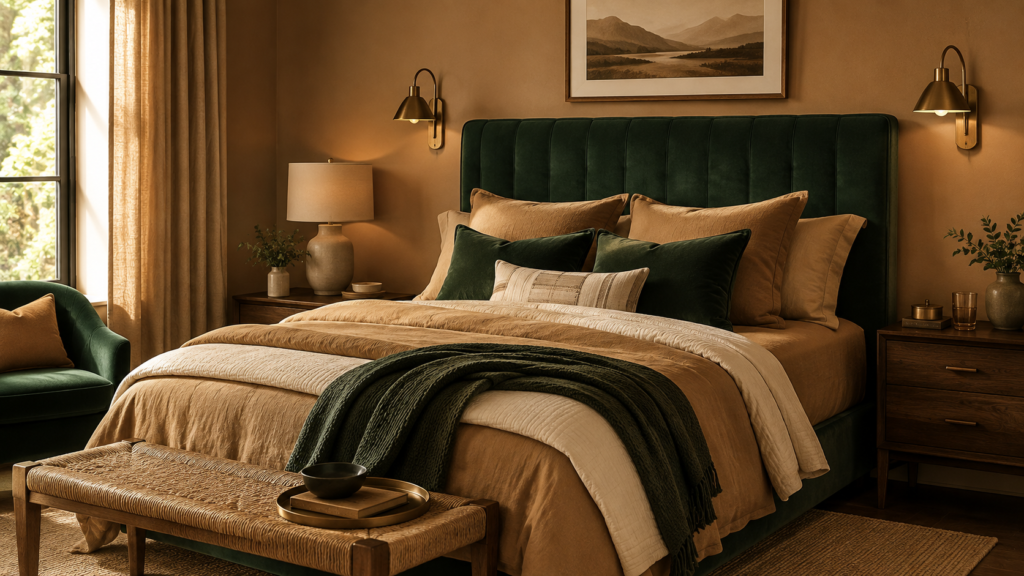
Let the bed frame set the tone. An upholstered bed in camel boucle, linen, or velvet gives you a soft, tactile base that emerald accents can play against. If you’d rather lead with green, an emerald velvet headboard against camel-toned walls creates an equally strong focal point — just don’t do both in full saturation, or the room loses its resting point.
Wood tones should lean warm. Walnut, oak, and rattan all sit naturally alongside camel. Avoid cool grey-washed woods here; they tend to fight the warmth of camel rather than support it.
Use one emerald furniture piece as an anchor, not several. A single emerald accent chair, bench, or ottoman does more work than scattering small green touches around the room. One confident piece reads as designed. Five small ones read as scattered.
Lighting
Warm-temperature bulbs are non-negotiable in this palette. Cool white light flattens camel and can make emerald look muddy. Stick to 2700K–3000K bulbs throughout.
Layer three light sources. A statement pendant or flush mount for ambient light, bedside lamps for task light, and a floor lamp or picture light for accent light. Brass or aged brass fixtures tie the warmth of camel to the richness of emerald better than chrome or matte black.
Let fabric shades do double duty. A camel linen lampshade softens the light and adds another texture layer without adding another colour decision.
Layout Tips
Keep the emerald moment opposite the door. Whatever holds your green — an accent wall, a headboard, a chair — place it where it’s the first thing you see when you walk in. This gives the room a clear focal point instead of a scattered feel.
Balance visual weight, not just colour. If your emerald piece is dark and heavy (a velvet headboard, a deep accent wall), balance it with lighter camel elements nearby, like a pale camel throw or a woven bench at the foot of the bed.
Leave breathing room around the accent wall. If you’re painting one wall emerald, keep the trim and ceiling in a soft white or warm cream. This stops the room from feeling boxed in, especially in a smaller space.
Small Space Adaptations
A full emerald accent wall isn’t always realistic in a smaller bedroom, and that’s fine. Here’s how to keep the pairing without the weight:
- Swap the accent wall for a headboard. An emerald upholstered or painted headboard gives you the same visual anchor at a fraction of the surface area.
- Use emerald in soft goods only. Bedding, a throw, and two accent pillows can carry the entire green story while walls stay camel or soft white.
- Choose a glossy or satin paint finish if you do paint a wall. It bounces more light back into the room than a flat finish, which matters in a space with limited windows.
- Keep the floor pale. A light rug or pale wood floor keeps the room feeling open even with a dark accent colour on one wall.
- Mirror placement helps double the light. Position a mirror to reflect a window or lamp, especially if the emerald wall is opposite it.
Budget vs. Luxury
| Element | Budget-Friendly Approach | Luxury Approach |
|---|---|---|
| Wall colour | Emerald accent wall in standard matte paint | Emerald grasscloth or plaster-finish wallpaper |
| Bedding | Camel cotton duvet with emerald throw pillows | Camel linen bedding with emerald silk or velvet euro shams |
| Headboard | Painted wood headboard in camel or cream | Fully upholstered emerald velvet headboard |
| Lighting | Brass-finish lamps from a home store | Vintage brass sconces or a custom pendant |
| Rug | Camel-toned jute or flatweave rug | Hand-knotted wool rug in a camel and emerald pattern |
| Accent chair | Slipcovered chair in a camel fabric | Emerald velvet accent chair with brass legs |
You don’t need to pick one column entirely. Most well-designed rooms mix both — a splurge on the headboard, savings on the lamps, for example.
Styling Mistakes to Avoid
Using too many competing metals. Pick one warm metal — brass, aged gold, or warm brushed bronze — and use it throughout. Mixing brass with chrome and matte black in the same room dilutes the warmth this palette relies on.
Making emerald the only colour with texture. If your green pieces are all velvet and your camel pieces are all flat cotton, the room can feel unbalanced. Bring texture — boucle, linen, wool, rattan — into the camel elements too.
Skipping a true neutral. Camel and emerald both carry visual weight. Without a resting point — a cream wall, a white ceiling, pale bedding — the eye never gets a break, and the room can feel busy rather than rich.
Going too dark without enough light sources. Emerald absorbs light. If you’re leaning into a saturated version of this palette, you need more light layers than a standard bedroom, not fewer.
Matching camel and emerald too literally. A camel bedspread with an emerald throw in the exact same fabric weight can look like a matched set rather than a designed room. Vary the textures and finishes even when the colours are coordinated.
DIY Improvements
- Paint a single emerald accent wall. This is the highest-impact, lowest-cost change you can make in an afternoon.
- Reupholster an old headboard in camel boucle or emerald velvet. A basic staple-gun reupholstery job can transform a dated frame for the cost of fabric alone.
- Dye or swap lampshades to a warm camel tone. This softens overhead and bedside light without rewiring anything.
- Add a stencilled or painted trim detail in emerald along a picture rail or door frame for a custom, tailored look without a full paint job.
- Layer thrifted brass frames and objects on a dresser or nightstand to bring in the metal accent affordably.
Style Variations
Art Deco Camel and Emerald: Lean into geometric patterns, fluted furniture details, and polished brass. Add a sunburst mirror or a fan-shaped headboard for period character.
Modern Warm Minimalist: Strip back pattern entirely. Let camel boucle, a single emerald chair, and warm wood do all the work. Keep walls in soft white or warm plaster.
Traditional English Bedroom: Bring in camel and emerald through a botanical wallpaper, layered with brass picture lights and a tufted camel bench at the foot of the bed.
Warm Boho: Add rattan, woven textures, and a mix of vintage brass alongside the camel and emerald base for a looser, more collected feel.
FAQ
Does camel and emerald green work in a small bedroom? Yes, as long as you keep the emerald concentrated in one or two elements — a headboard or bedding — rather than spreading it across walls and furniture. Keeping the floor and ceiling pale also helps the room feel open.
What metal finish pairs best with camel and emerald? Brass and aged gold pair most naturally with this combination. They pick up the warmth in camel and add richness to emerald without introducing a cool undertone that competes with either colour.
Is this palette too dark for a bedroom meant for sleeping? Not if you control the ratio. Keeping camel as the dominant 60% share, with emerald layered in as an accent, keeps the room grounded and restful rather than heavy.
Can I use this palette in a rental where I can’t paint? Yes. Bedding, a headboard slipcover, curtains, a rug, and lamp shades can carry the entire palette without touching the walls.
What flooring works best with camel and emerald? Warm-toned wood floors, in oak or walnut, support this palette best. If you have cooler-toned or grey flooring, lean on a camel rug to bridge the warmth back in.
A bedroom in camel and emerald green doesn’t need much to feel finished — just the right ratio, warm light, and one confident green moment doing the talking.