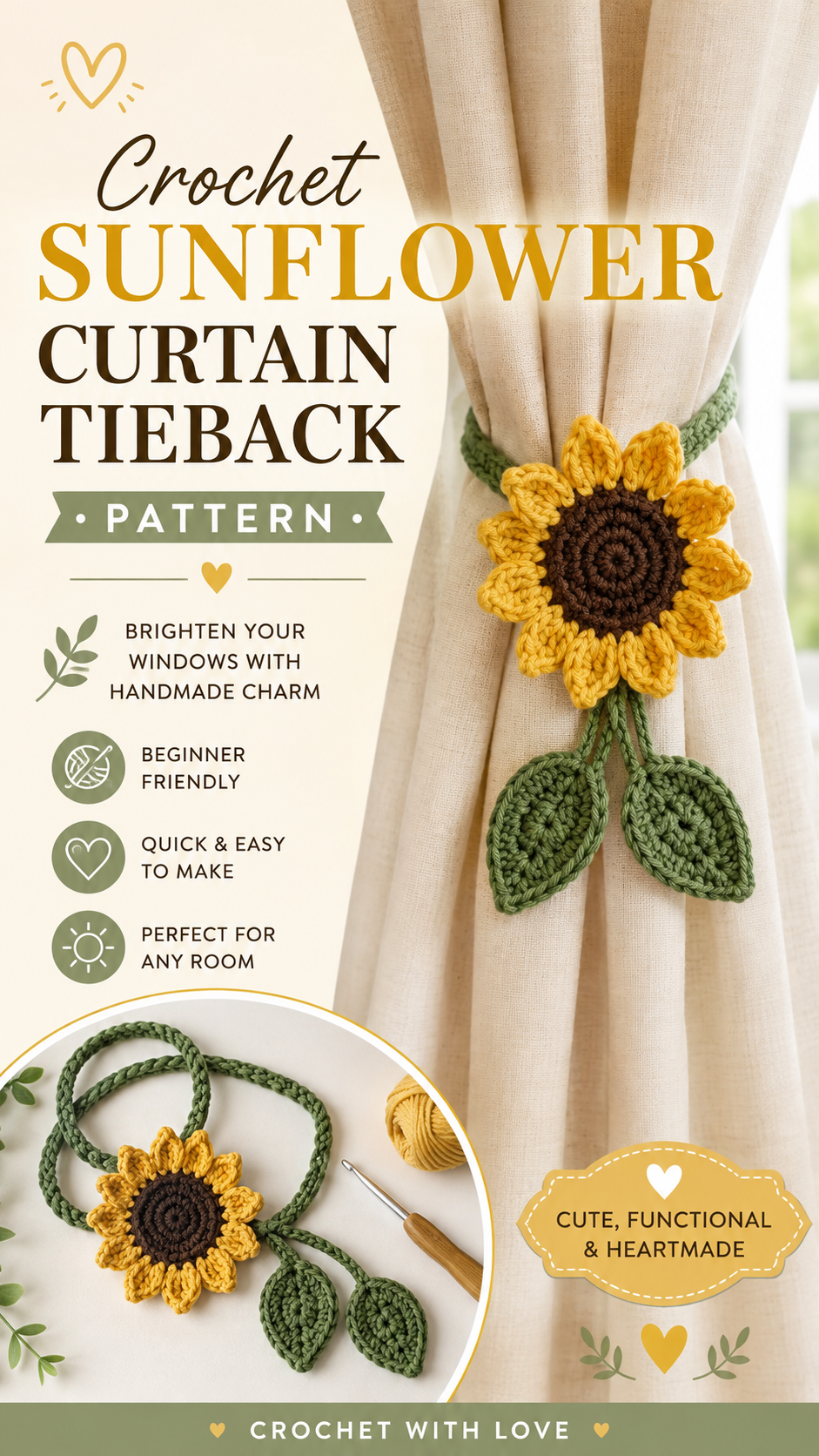
A curtain tieback is a small detail. But it’s the kind of small detail that quietly upgrades a whole room.
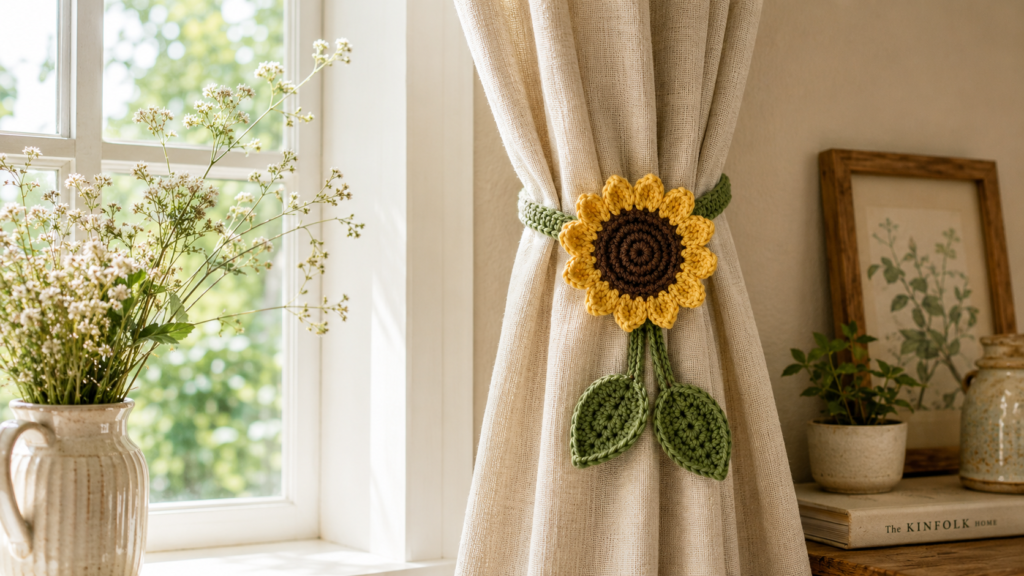
This crochet sunflower tieback pattern is beginner-friendly, budget-proof, and genuinely useful — it holds your curtains open and adds a handmade charm you can’t buy off a shelf. Below you’ll find the full pattern, styling advice, and everything you need to make one from scratch.
Why This DIY Works
Sunflower motifs read as warm and grounded rather than fussy. They pair easily with farmhouse, cottagecore, boho, and even modern-rustic interiors without looking like a themed craft project.
Crochet also has a texture advantage. A flat, printed floral fabric sits quietly against a curtain. A dimensional crocheted flower catches light differently depending on the time of day, which gives a window more visual depth than most store-bought hardware.
The functional side matters too. Tiebacks that actually hold curtain weight — instead of thin ribbon that slips — keep a room looking intentional rather than half-finished.
Designer Note: Skip matching your tieback exactly to your curtain color. A soft contrast — sunflower yellow against linen, sage, or dusty blue — reads as styled rather than coordinated straight out of a set.
Materials & Tools
You don’t need a large yarn stash for this project. Here’s the full list:
| Item | Purpose | Notes |
|---|---|---|
| 4-ply cotton yarn (yellow) | Petals | Cotton holds shape better than acrylic for this project |
| 4-ply cotton yarn (brown) | Flower center | A darker gold works too |
| 4-ply cotton yarn (green) | Leaves and tieback strap | Choose a shade that reads “stem,” not neon |
| 3.5mm crochet hook | Standard hook size for this yarn weight | Adjust if your tension runs tight or loose |
| Tapestry needle | Sewing pieces together | Blunt tip prevents splitting the yarn |
| 2 small buttons | Fastening loop | Wood or shell buttons suit farmhouse and boho styles |
| Scissors | Trimming yarn ends | — |
| Small amount of stuffing (optional) | Gives the flower center dimension | Skip for a flatter, more minimalist look |
Quick Win: Buy your yarn in a bundle pack rather than individual skeins. Most cotton DK bundles include yellow, brown, and green together, and you’ll likely have leftover yarn for a second tieback or a matching coaster.
Key Stitches You’ll Need
This pattern uses four stitches. If you already crochet, you know all of them.
- Slip stitch (sl st) — joining rounds and finishing edges
- Chain stitch (ch) — foundation rows and loops
- Double crochet (dc) — the main stitch for petals, leaves, and the strap
- Incomplete double crochet — used to shape petal and leaf points
If any of these are new to you, a five-minute video tutorial will get you comfortable faster than written instructions alone. This pattern doesn’t require anything beyond that.
Step-by-Step Pattern
Part 1: The Sunflower Center
- Using brown yarn, chain 4 and join with a slip stitch to form a ring.
- Round 1: Chain 1, work 8 single crochet stitches into the ring, join with a slip stitch. (8 stitches)
- Round 2: Chain 1, work 2 single crochet in each stitch around, join. (16 stitches)
- Fasten off, leaving a long tail for sewing.
Part 2: The Petals
- Switch to yellow yarn and join it to any stitch on the outer edge of the brown center.
- For each petal: chain 3, double crochet into the same stitch, then work an incomplete double crochet to create a point. Slip stitch into the next stitch on the center to anchor the petal.
- Repeat around the full circle — you should end up with 12 to 14 petals, depending on how full you want the flower.
- Fasten off and weave in ends.
Part 3: The Leaves
- Using green yarn, chain 20.
- Starting from the second chain from the hook, work double crochet stitches down the chain, using an incomplete double crochet at the tip to form a point.
- Turn and repeat the same shaping along the other side of the chain.
- Repeat this leaf shape twice — most versions look best with two leaves total, though you can add more for a fuller look.
Part 4: The Tieback Strap
- Still in green yarn, chain a length that fits comfortably around your curtain (roughly 25 to 30 rows of 10 double crochet stitches wide works for most curtain panels — measure your own curtain bundled loosely first).
- Work double crochet across each row until the strap reaches your desired length.
- At one end, chain a small loop instead of finishing straight — this becomes the buttonhole.
- Sew a button onto the opposite end.
Part 5: Assembly
- Sew the leaves to the underside of the sunflower center, positioning them so they peek out slightly from behind the petals.
- Center the finished sunflower on the middle of the strap and stitch it down securely using the tapestry needle.
- Weave in any remaining loose ends.
- Wrap the strap around your curtain, loop the buttonhole over the button, and adjust until it sits where you want it.
Budget vs. Luxury Materials
| Budget Version | Luxury Version | |
|---|---|---|
| Yarn | Acrylic blend, big-box craft store | 100% mercerized cotton or linen-blend yarn |
| Buttons | Plain plastic | Hand-carved wood, brass, or mother-of-pearl |
| Finish | Air-dry as-is | Lightly steam-block the flower for crisper petal shape |
| Approx. cost per pair | Under $5 | $15–25 |
Both versions use the same pattern — the difference is entirely in material choice, which is part of why this project scales well for gift-giving or bulk-making for multiple rooms.
How to Style It in Your Home
Kitchen windows benefit from a single, smaller-scale sunflower tieback — it reads as a detail rather than a statement.
Living rooms with heavier drapery can handle two full-size flowers per curtain panel, one at the tieback point and a second smaller one near the top hook.
Nurseries and reading nooks pair well with a pastel palette — swap the classic yellow-and-brown for cream petals and a soft green center if you want something quieter.
Common Styling Mistakes to Avoid
- Making the strap too short. A tieback that barely wraps around the curtain will strain the stitches and eventually stretch out of shape. Measure generously.
- Skipping the blocking step on cotton yarn. Unblocked cotton petals can curl at the edges instead of lying flat.
- Using one flower size for every window in the house. Match the scale of the flower to the weight and width of the curtain panel — an oversized bloom on a narrow curtain looks unbalanced.
- Choosing yarn colors that fight with the wall behind the window rather than complementing it. Hold your yarn up against the wall before you start.
Maintenance Note: Hand wash cotton tiebacks in cool water and reshape the petals while damp. Avoid the dryer — heat can felt the fibers and shrink the flower slightly.
Variations Worth Trying
- Two-tone petals using a lighter and darker yellow for shading
- Mini sunflower version scaled down for cafe curtains or kitchen valances
- Autumn palette — rust, mustard, and deep green for a seasonal swap-in
- Beaded center — small wooden or glass beads sewn into the brown center for extra texture
FAQ
How long does one tieback take to make? Most beginners finish one in two to three hours, spread across a couple of sittings.
Can I use acrylic yarn instead of cotton? Yes, though cotton holds its shape better around a curtain and drapes less limply than acrylic.
Do I need advanced crochet skills? No. This pattern only uses slip stitch, chain stitch, double crochet, and incomplete double crochet.
Can I make this without buttons? Yes — a simple tied knot or a small strip of Velcro works as a substitute fastening method.
Will this work on heavy blackout curtains? It’s better suited to light-to-medium weight curtains. For heavier fabric, double up the strap width for extra support.
There’s something satisfying about a window detail nobody else has — made in an afternoon, holding its shape for years.