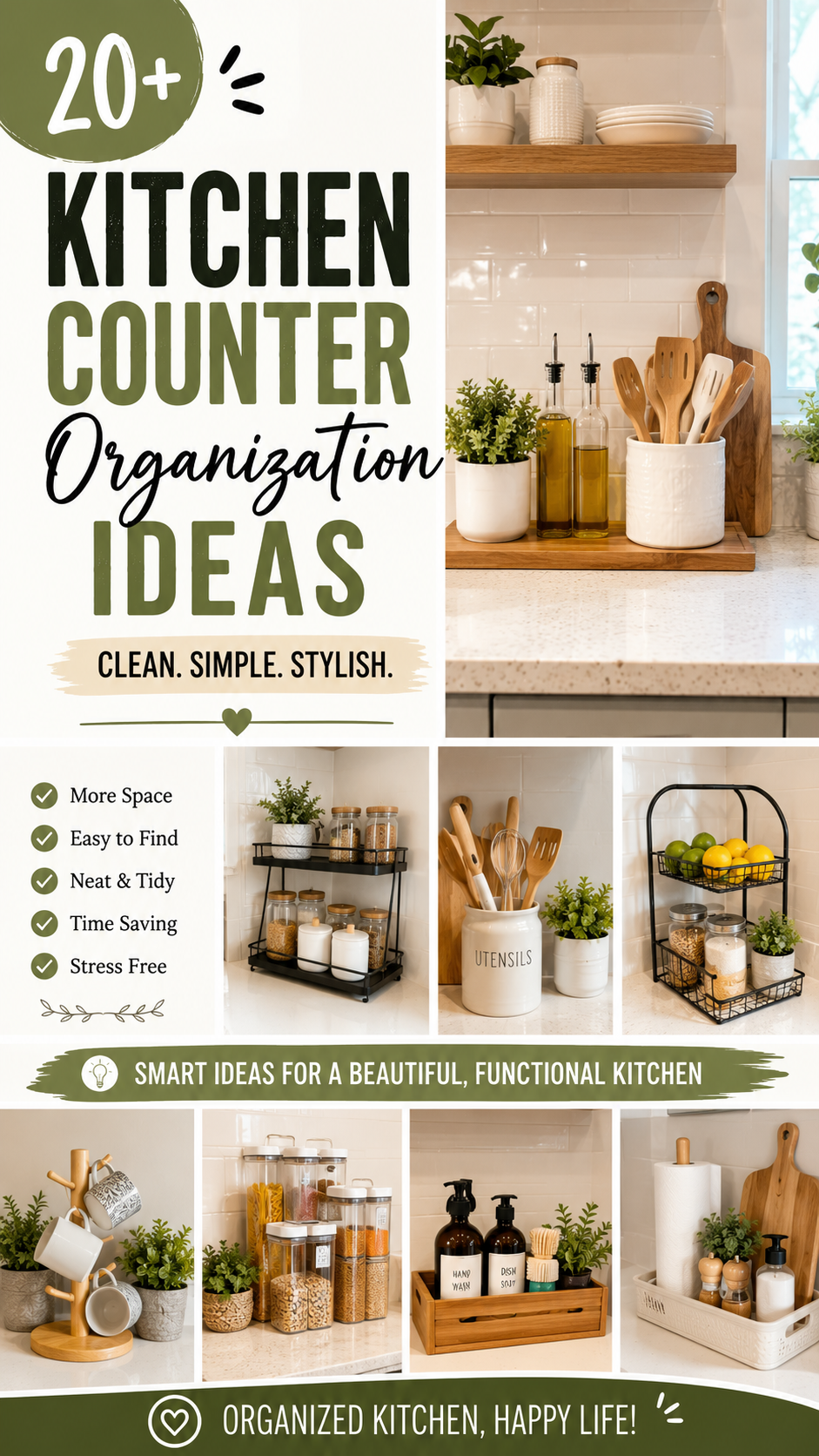
Most kitchen counter advice stops at “get some baskets.” That’s not why counters get messy again within a week. The real problem is usually that the counter is being asked to do five jobs at once — prep space, storage, mail drop, small-appliance parking, and catch-all — with no system deciding what actually belongs there.
This guide isn’t a list of products to buy. It’s a way of thinking about counter space by function, so whatever organizers you choose actually stick.
Why Counters Get Cluttered in the First Place
Counters clutter for a predictable reason: they’re the easiest flat surface in the house, and easy surfaces attract everything without a designated home.
Mail, keys, chargers, and random small items land there because there’s no better option nearby. Small appliances stay out because putting them away feels like extra steps every single use. And prep space quietly shrinks until there’s barely room to chop an onion.
The fix isn’t more storage. It’s deciding, zone by zone, what’s actually allowed to live on the counter — and being honest about what isn’t.
Designer Note
Before adding a single organizer, clear the counters completely for 48 hours and only put back what you use daily. What’s missing after two days usually belongs in a cabinet, not on display.
The Zone Method: Splitting Counters by Function
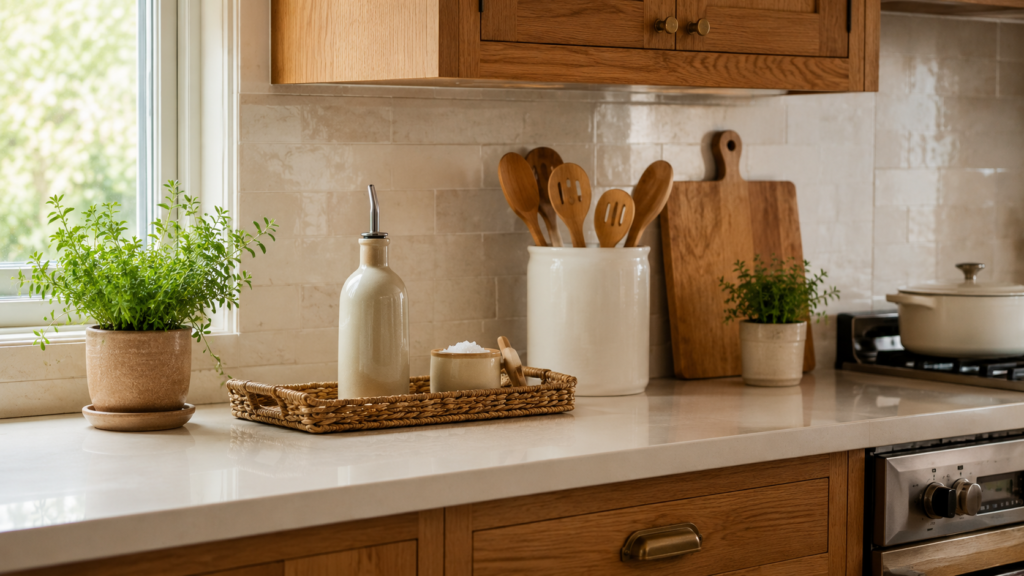
Rather than treating the whole counter as one space, it helps to break it into zones with a clear job.
The prep zone. This should be the largest clear stretch of counter, ideally near the sink or stove. Nothing permanent belongs here — no appliances, no decor, no mail.
The landing zone. A small, contained spot near the entry point for keys, mail, and phones. Giving this clutter an actual home keeps it from spreading across the rest of the counter.
The appliance zone. One stretch reserved for daily-use appliances — usually a coffee maker or kettle. Anything used less than a few times a week should be stored away, not displayed.
The styling zone. A small area, often near a window or the end of the counter, reserved purely for a plant, a tray, or a few objects that make the kitchen feel finished.
Most cluttered kitchens don’t lack storage — they lack this kind of boundary between zones.
Practical Organization Ideas by Zone
For the prep zone:
- Keep only a knife block or magnetic strip and a cutting board in reach — everything else goes in a drawer.
- Use a small caddy for oil, salt, and daily-use seasonings instead of leaving a full spice collection out.
For the landing zone:
- A shallow tray or bowl for keys and small items keeps them from scattering across the whole counter.
- A wall-mounted mail sorter just above the counter, rather than on it, frees up the surface entirely.
For the appliance zone:
- An appliance garage — a cabinet with a roll-up or lift door — hides toasters and blenders while keeping them close to an outlet.
- Stacked risers under a coffee maker or kettle add storage underneath without using more counter length.
For the styling zone:
- One tray grouping three or four objects — a plant, a candle, a ceramic dish — reads as intentional. Loose, ungrouped items rarely do.
- Rotate seasonal items here instead of adding new ones on top of what’s already there.
Quick Win
Group anything you keep out — oils, utensil crocks, cutting boards — onto a tray. It looks tidier instantly, and it makes wiping down the counter a one-motion task instead of moving six things individually.
Storage Solutions Worth the Counter Space
Not every organizer deserves a spot. These earn their place because they solve a real daily friction point.
| Organizer | Best For | Why It Works |
|---|---|---|
| Utensil crock | Daily-use tools near the stove | Faster than a drawer for things used constantly |
| Under-cabinet shelf | Mugs, spices, small jars | Uses dead vertical space instead of the counter |
| Lazy Susan tray | Oils, condiments, tea | Keeps clustered items from sprawling |
| Wall-mounted knife strip | Knives | Frees prep space and keeps blades visible and safe |
| Appliance garage | Toaster, blender, coffee maker | Hides bulk without moving it far from power outlets |
| Tiered fruit basket | Produce that doesn’t need refrigeration | Adds storage vertically instead of across the counter |
Materials and Finishes That Look Intentional
Organizers only look styled, not cluttered, when their materials feel consistent with the rest of the kitchen.
Woven baskets and wood trays suit warmer, farmhouse, or Japandi kitchens. Matte ceramic and marble-look trays suit more modern or minimalist spaces. Mixing metals — say, a chrome utensil crock next to a brass canister — is one of the fastest ways to make an otherwise organized counter look mismatched.
Designer Note
Pick one dominant material family (wood, ceramic, or metal) for anything visible on the counter, and let one contrasting accent break it up. Three or four different materials competing at once is what makes an organized counter still look busy.
Common Mistakes That Undo Good Organization
Buying organizers before deciding what goes where. A beautiful caddy solves nothing if it’s holding items that shouldn’t be on the counter at all.
Leaving too many small appliances out “for convenience.” Every appliance left out shrinks usable prep space, even if it’s tucked to one side.
Treating decor and function as separate problems. A tray that holds daily-use items and looks good is more effective than a purely decorative object that adds nothing but visual weight.
Ignoring vertical space. Wall-mounted shelves, hooks, and racks free up significant counter length, but they’re often the last thing people think to add.
Small Kitchen Adjustments
In a small kitchen, the zone method matters even more, because there’s less room for a zone to quietly expand into the next one.
Corner counter space, which is often awkward to use for prep, works well as a dedicated appliance or landing zone instead. A slim rolling cart can act as an extra prep surface that tucks away when it’s not needed, effectively adding counter space without adding permanent square footage.
Wall-mounted solutions do more work in small kitchens than in larger ones — every item moved off the counter and onto a wall gives back real, usable prep space.
Budget Picks vs. Higher-Investment Picks
| Element | Budget-Friendly Approach | Higher-Investment Approach |
|---|---|---|
| Appliance storage | A tray to visually contain the toaster and kettle | A built-in appliance garage with a roll-up door |
| Utensils | An affordable ceramic or metal crock | A custom in-drawer utensil organizer |
| Landing zone | A simple bowl for keys and mail | A built-in drop zone with hooks and a charging shelf |
| Styling | A single plant in a basic pot | A curated tray with ceramic, glass, and wood pieces |
Both routes can look equally finished — the higher-investment approach mostly buys back counter space permanently, rather than just organizing what’s already there.
A Simple Weekly Reset Routine
Even a well-organized counter drifts back toward clutter without a light maintenance habit.
- Clear the prep zone completely at the end of each day — nothing stays overnight except what’s zoned to live there.
- Once a week, empty the landing zone bowl or tray and redistribute anything that’s overstayed.
- Wipe the appliance zone and check whether anything sitting there has gone unused for more than a week.
- Refresh the styling zone occasionally rather than adding to it — swap, don’t stack.
Frequently Asked Questions
Do I need to buy new organizers, or can I use what I already have? Most kitchens already own enough trays, jars, and bowls to organize a counter — the zone system usually matters more than new purchases.
What if I don’t have room for an appliance garage? A simple tray or riser to visually contain appliances does a lot of the same work, just without hiding them completely.
How much counter space should stay completely clear? As a rough guide, at least one continuous stretch — ideally near the stove or sink — should stay fully clear for prep at all times.
Final Thought
An organized counter isn’t really about how many baskets or trays are on it. It’s about whether the counter still has room to do its actual job — prepping food — without everything else crowding in. The kitchens that stay tidy aren’t the ones with the most organizers. They’re the ones where every item on the counter has a reason to be there.