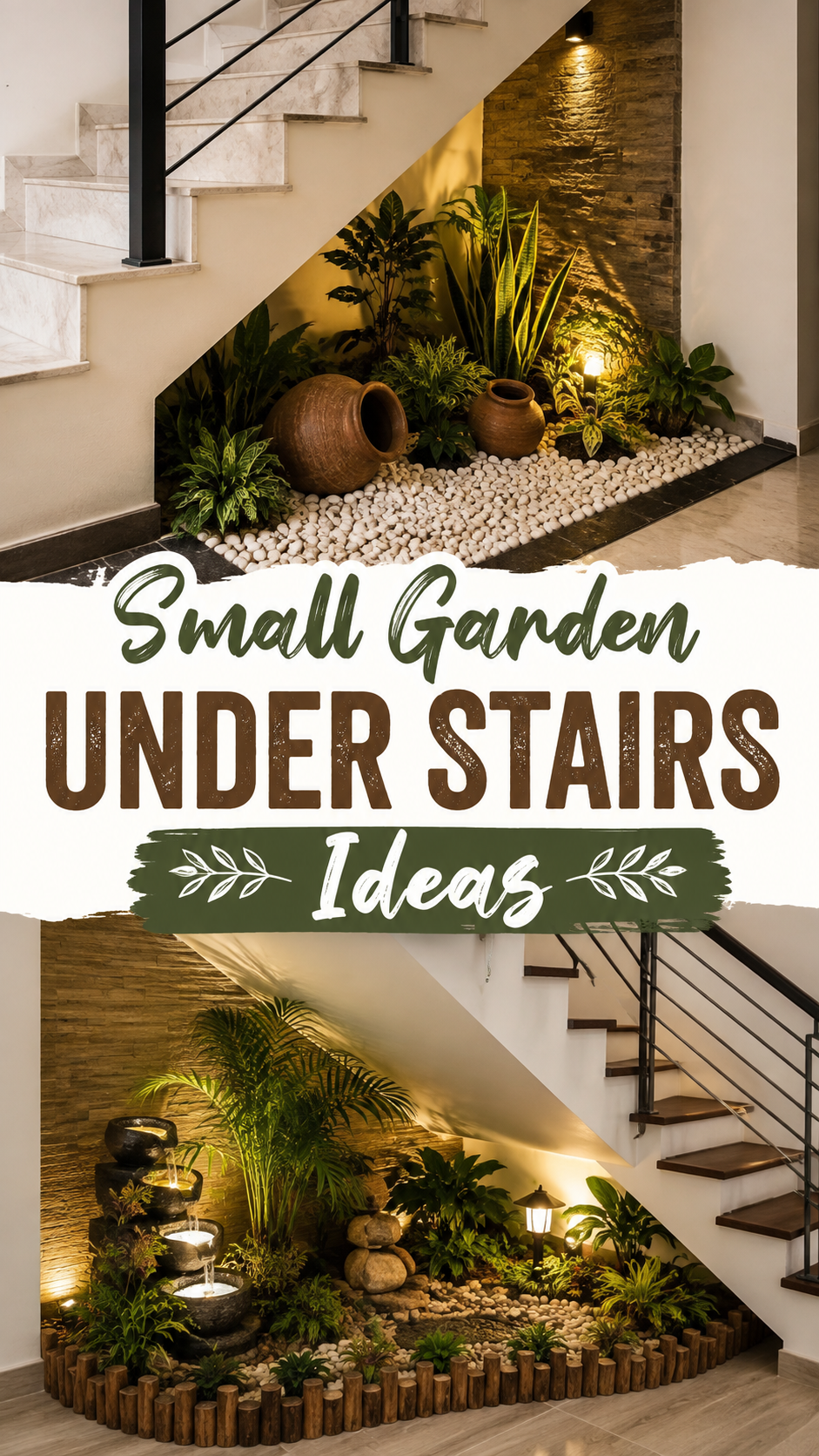
That triangle of space under your staircase has been quietly wasted for years. Maybe it’s holding a vacuum cleaner. Maybe it’s just empty and dusty.
A small garden under the stairs fixes that. It’s one of the few design moves that turns an awkward leftover space into the first thing guests notice when they walk in.
This guide covers every practical angle: which style fits your home, which plants actually survive there, how to light it properly, and where to spend versus save.
Why This Idea Works So Well
Staircases create a triangular void that’s too shallow for a closet and too small for real furniture. Most homeowners either box it in with doors or leave it as dead storage.
A garden solves the proportion problem. Plants don’t need a rectangular footprint. They fill an irregular, sloped space the way furniture never can.
It brings the outdoors into your entryway. Entry halls are usually the most sterile room in a home — no windows, no personality. A pocket of greenery softens that immediately.
It hides architectural awkwardness. The low ceiling height under a staircase is hard to style around. Low plants and ground-level pebble beds don’t fight that slope; they follow it.
Designer Note: The most successful under-stairs gardens are treated as a single design object, not a random cluster of pots. Pick one material story — pebbles, moss, or a planter box — and repeat it instead of mixing five different textures.
Choosing Your Style Direction
The right look depends on the rest of your home, not just personal taste.
| Style | Best For | Signature Materials |
|---|---|---|
| Japandi | Minimalist, calm entryways | Raked pebbles, moss balls, low ceramic bowls |
| Scandinavian | Bright, pale-wood homes | Whitewashed planters, birch stems, sansevieria |
| Farmhouse | Traditional or cottage homes | Galvanized troughs, ferns, woven baskets |
| Boho | Eclectic, plant-heavy homes | Layered pots, trailing pothos, rattan accents |
| Luxury | Formal entries, high ceilings | Marble chip beds, uplighting, sculptural topiary |
Match the palette of the staircase itself. A dark wood banister pairs naturally with deep green foliage and warm brass accents. A painted white staircase reads best with pale ceramics and silvery-leafed plants like eucalyptus.
Colour Palette
Keep the palette to three tones so the space reads as intentional rather than cluttered.
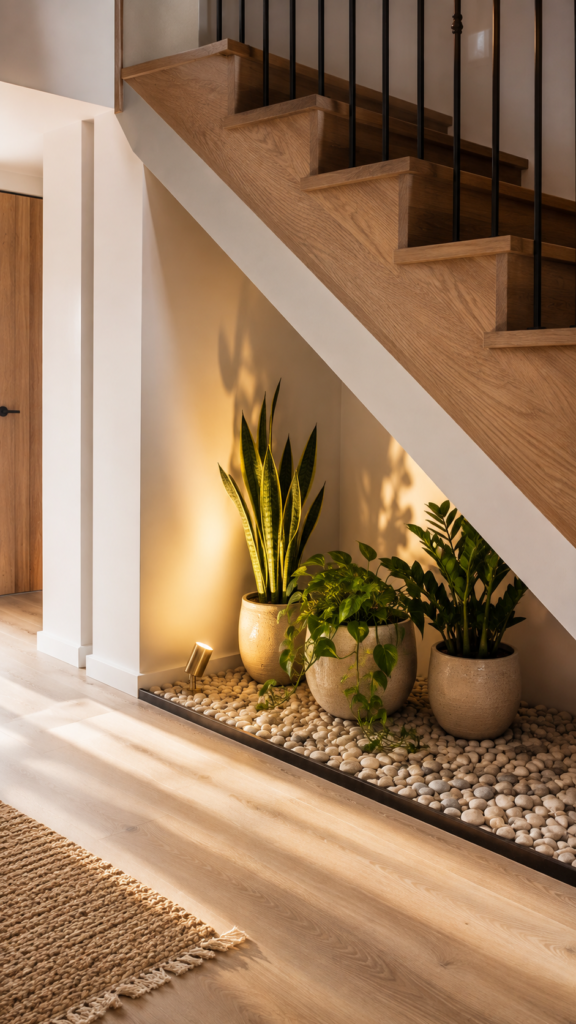
- A base tone — the pebbles, gravel, or planter material (white marble chip, charcoal slate, or warm terracotta).
- A foliage tone — deep green for drama, silvery-sage for a softer look.
- An accent tone — one metal finish (brass, matte black, or aged bronze) used on pots, edging, or lighting fixtures.
Avoid patterned tile or bright accent colors here. This is a transitional space people glance at while walking through, not a place for a bold statement wall.
Layout Tips
Work with the slope, not against it. The tallest plant goes at the back where the ceiling is highest. The lowest, flattest planting — moss, pebbles, low succulents — goes at the front where the stairs meet the floor.
Leave a border. A thin strip of gravel or a low wooden edge between the garden and the walking path keeps soil and mulch from migrating onto the floor.
Think in layers, not rows. Group plants in odd numbers (three or five), varied in height, rather than lining them up evenly. Uneven groupings read as more natural.
Respect the traffic line. If people walk close to the stairs, keep foliage pulled back at least six inches from the edge so nothing brushes against legs or bags.
Quick Win: If your under-stairs triangle is less than 12 inches deep at its shallowest point, skip planters entirely and go with a flat pebble-and-moss bed. It reads as intentional even in a sliver of space.
Plant Selection for Low-Light Corners
Most under-stairs spaces get little to no direct sun, so plant choice matters more here than almost anywhere else in the home.
Best performers in low light:
- Snake plant (sansevieria) — tolerates near-total shade and infrequent watering
- ZZ plant — thrives in dim corners and handles neglect well
- Pothos — trails beautifully off a raised planter edge
- Peace lily — adds a flowering element and signals when it needs water by drooping
- Moss — needs humidity more than light, ideal for pebble-bed gardens
Skip these regardless of how appealing they look:
- Succulents and cacti (they need direct sun and will stretch or rot in shade)
- Fiddle leaf figs (notoriously fussy even in bright rooms)
- Any flowering annual that depends on daily sun exposure
If natural light is truly nonexistent, a small clip-on grow light hidden behind a plant or beam solves the problem without looking clinical.
Lighting
Lighting is what separates a styled garden from a plant graveyard.
Uplighting placed at the base and angled toward the stairs creates dramatic shadows on the underside of the treads — this is the single highest-impact lighting move for a luxury look.
LED strip lighting tucked under a shelf or the first stair tread gives a soft glow without visible fixtures.
Warm white (2700K–3000K), never cool white. Cool light makes greenery look sickly and clinical; warm light makes it look alive.
On a timer or smart switch, so the space lights itself at dusk without anyone remembering to flip a switch.
Budget vs. Luxury Comparison
| Element | Budget Approach | Luxury Approach |
|---|---|---|
| Ground cover | Pea gravel from a hardware store | Polished marble chip or river stone |
| Planters | Terracotta pots, painted | Custom-fit built-in planter boxes |
| Lighting | Battery LED puck lights | Hardwired recessed uplights |
| Plants | Pothos, snake plant cuttings | Mature specimen plants, topiary |
| Edging | Painted wood trim | Brass or blackened steel edging strip |
| Total range | $60–$150 | $600–$2,500+ |
The single biggest upgrade for the money is almost always lighting, not plants. A $30 warm LED strip transforms a budget setup more than doubling the plant count would.
Luxury Alternatives
For homes with taller staircases or a more formal entry, a few upgrades push the space from “nice touch” to “designer feature”:
- A built-in planter box with a custom liner, matched to the wood tone of the stairs
- A water feature — a small recirculating pebble fountain adds sound, not just visuals, and works particularly well in stone-heavy Mediterranean or luxury interiors
- Sculptural topiary in place of loose plantings for a more architectural, tailored look
- A glass or brass edging strip that catches light and defines the garden’s boundary cleanly
Small Space & Narrow Staircase Ideas
Not every home has a generous under-stairs void. For staircases with only a few inches of clearance:
Go vertical instead of deep. A single tall trailing plant on a slim pedestal uses almost no floor space.
Use a shallow tray garden. A 3-inch-deep tray filled with moss and two or three small pots can sit flush against the wall.
Mirror-back the space. A slim mirror panel behind a narrow planting doubles the visual depth without adding a single inch of real floor space.
Styling Mistakes to Avoid
Overcrowding the footprint. More plants doesn’t read as lush — it reads as cluttered in a space this size. Three well-chosen plants outperform eight mismatched ones every time.
Ignoring drainage. Under-stairs spaces are often carpeted or hardwood, not tiled. Any planting with soil needs a sealed liner or drainage tray underneath, no exceptions.
Skipping humidity protection. Moss and pebble gardens near wood stairs can trap moisture against the structure over time. A waterproof barrier between the garden bed and any wood surface prevents warping.
Choosing plants for looks alone. A plant that needs bright light will decline within weeks in a shaded stairwell, no matter how good it looked in the store.
Forgetting the maintenance angle. A garden that requires daily attention in a low-traffic corner of the house will get neglected fast. Low-maintenance plant choices aren’t a compromise here — they’re the whole point.
Maintenance Note: Wipe leaves down monthly to remove dust buildup, which is worse in low-light corners since plants can’t photosynthesize efficiently through a dusty layer. Check the drainage tray every two weeks if the space isn’t tiled.
DIY Improvements
Build a simple plywood planter box, stained to match the stair treads, sized to fit the exact triangular footprint — this single project does more for cohesion than any amount of decor shopping.
Add a pebble border using leftover landscaping stone from a hardware store, framed with a thin strip of scrap wood painted to match the trim.
Install battery-powered LED pucks under the first two stair treads for an instant lighting upgrade with zero wiring involved.
Repurpose a bookshelf ladder as a tiered plant stand, angled to follow the slope of the stairs above it.
FAQ
Does an under-stairs garden need real plants, or do artificial ones work? High-quality artificial plants work well in spaces with zero natural light or heavy foot traffic where real plants would struggle. For anywhere with even indirect light, real low-maintenance plants tend to look more convincing up close.
Will a garden under the stairs damage the wood? Only if moisture isn’t managed. A waterproof liner or tray between any soil, moss, or pebbles and the wood structure prevents warping or staining.
How much does a basic version cost? A simple pebble-and-plant setup with two or three low-light plants, gravel, and battery LED lighting typically runs $60–$150 depending on plant size and local pricing.
What if there’s absolutely no natural light? Snake plants and ZZ plants tolerate near-total darkness, and a small hidden grow light can supplement further without altering the look of the space.
How often does this kind of garden need maintenance? With the right plant choices, expect watering every 1–2 weeks and a dusting pass once a month. It’s designed to be low-effort by nature.
The space under your stairs has been waiting this whole time. Give it a job.