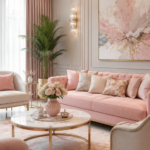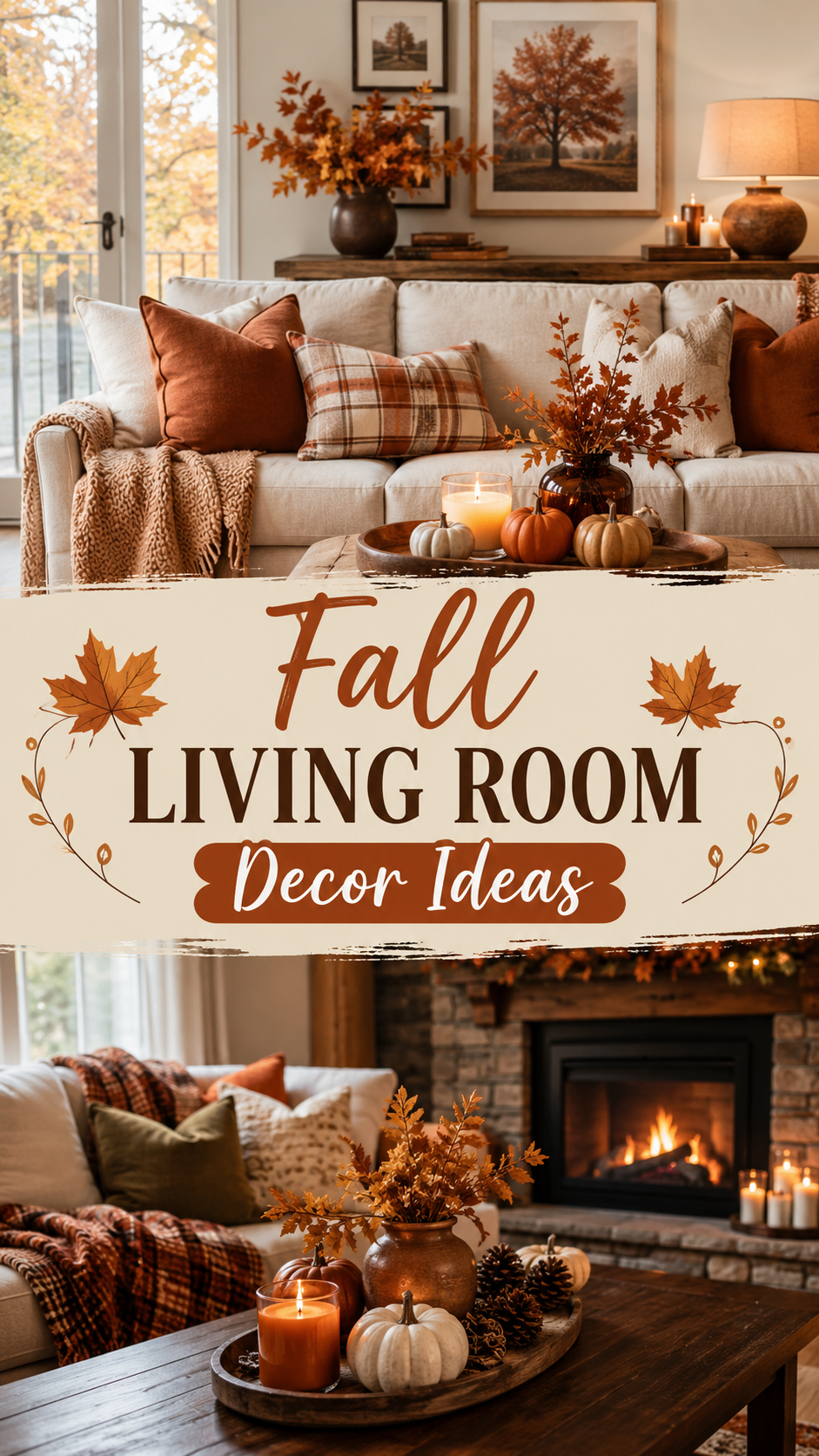
Fall doesn’t need a full redesign to feel real in your living room. A few intentional swaps — color, texture, light — do most of the work.
This guide walks through exactly which changes matter, which are optional, and how to avoid the “pumpkin overload” look that reads more Halloween aisle than editorial autumn.
Why This Style Works
Fall decor succeeds because it leans on contrast: warm tones against cool daylight, heavy texture against smooth surfaces, low light against bright rooms.
Your eye reads comfort through texture first, color second. That’s why a chunky knit throw registers as “cozy” faster than a burnt-orange pillow does.
The season also shortens daylight hours. A living room that relies only on overhead light starts to feel flat by 5pm — fall styling naturally corrects this by adding lamps, candles, and warmer bulbs.
Quick Win: Start with texture, not color. Add one wool throw and one textured pillow before buying anything seasonal-specific. You’ll feel the shift immediately.
Colour Palette
Fall palettes work in layers, not a single dominant shade.
| Layer | Colors | Where to Use |
|---|---|---|
| Base | Warm neutrals — camel, oatmeal, taupe | Sofa, rug, walls |
| Accent | Terracotta, rust, mustard | Pillows, throws, one accent chair |
| Deep | Espresso brown, forest green, burgundy | Small accessories, candle vessels, books |
Designer Note: Limit yourself to one base, one accent, and one deep tone per room. Rooms that mix all three fall palettes at full saturation start to look like a craft fair instead of a living space.
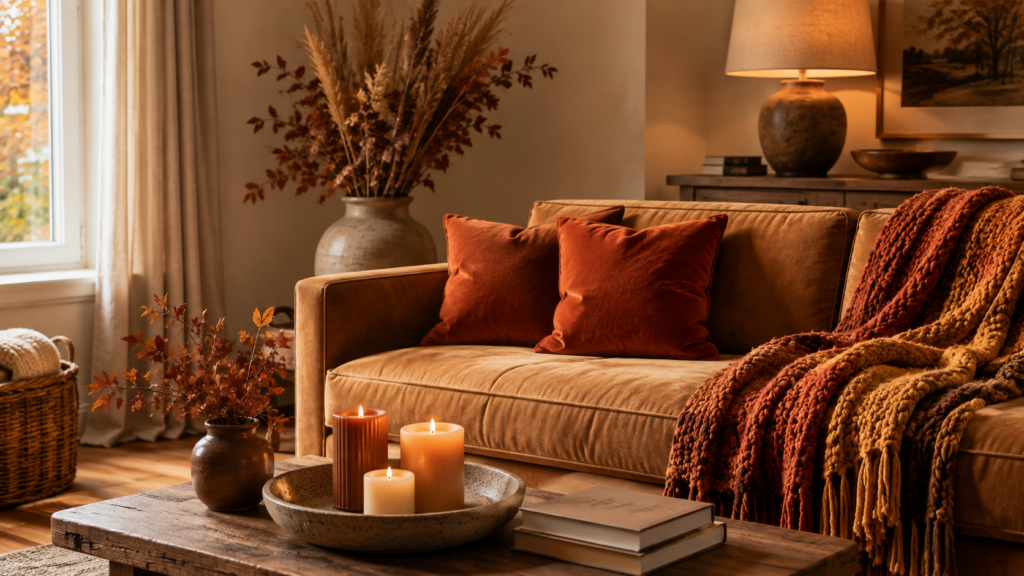
A neutral-leaning living room only needs the accent layer. Two rust pillows and a mustard throw on a beige sofa will shift the whole mood without a single pumpkin.
Furniture Ideas
Furniture doesn’t need to change for fall — but a few swaps make the seasonal shift feel intentional rather than decorative-only.
- Swap slipcovers or throws on the sofa in a heavier weave — boucle, corduroy, or wool blend
- Add one accent chair in leather or velvet if your seating is currently all linen or cotton
- Bring in a low wood or rattan coffee table tray to anchor seasonal styling in one contained spot
- Layer a vintage or wood-frame mirror near the seating area to bounce low fall light around the room
Budget move: A $30 boucle throw draped over an existing sofa does more visual work than a $300 seasonal accent chair. Save furniture purchases for pieces you’ll keep year-round.
Lighting
Fall lighting has one job: replace the daylight you’re losing.
Layer three light sources in the living room — overhead, table-level, and low ambient (candles or a floor lamp with a warm bulb). A single ceiling fixture on its own will always feel cold once the clocks change.
Switch to bulbs in the 2700K–3000K range if you haven’t already. This single change affects the whole room’s mood more than any decor object will.
Candles matter here beyond scent. Grouped in odd numbers (three or five) at varying heights, they create the kind of low flicker that makes a room feel occupied even when it’s empty.
Layout Tips
Fall is a good season to angle seating slightly inward. Long, formal arrangements read cooler; a tighter conversational layout reads warmer, which matches the season’s mood.
Pull furniture a few inches off the walls. Rooms with everything pushed to the perimeter feel more like a waiting room than a living space, especially once natural light drops.
If your living room has a fireplace, treat the mantel as the seasonal focal point and let everything else stay simple. One strong vignette beats five scattered ones.
Styling Mistakes
Buying only orange. A room styled entirely in orange and rust reads costume-y rather than seasonal. Balance with neutrals and one deep tone.
Skipping texture entirely. Color changes alone won’t register as “fall” without a textural shift — velvet, wool, boucle, or nubby weaves need to be part of the plan.
Overcrowding the coffee table. A tray with a candle, a small stack of books, and one natural element (dried branches, a small gourd) reads intentional. Six seasonal objects crammed together reads cluttered.
Ignoring scale. A single tiny pumpkin on a large coffee table disappears visually. Group in threes or choose one larger piece instead.
Budget vs. Luxury
| Element | Budget Option | Luxury Alternative |
|---|---|---|
| Throw blanket | Acrylic-blend knit, $20–30 | Alpaca or merino wool, $90–150 |
| Pillow covers | Cotton canvas in rust/mustard, $15 each | Velvet or boucle, $45–70 each |
| Candles | Unscented pillar set, $12 | Hand-poured soy in cedar or amber, $35–55 |
| Coffee table styling | Thrifted tray + dried branches, $10 | Curated ceramic tray + designer vase, $80–120 |
| Lighting | Warm-tone LED bulb swap, $8 | Floor lamp with brass or wood base, $150–300 |
The gap between these two columns is almost entirely about material, not concept. A budget wool-blend throw in the right color does 80% of what a $150 alpaca throw does visually.
Small Space Ideas
Small living rooms benefit from restraint more than any other room type this season.
- Choose one seasonal color story and repeat it in two or three spots rather than scattering accents everywhere
- A single oversized textured pillow reads better than four small mismatched ones
- Wall-mounted candle sconces free up surface space that small coffee tables don’t have to spare
- Mirrors near the main seating area help bounce the lower fall light and keep the room from feeling dim and cramped at once
Designer Note: In compact rooms, texture change alone (swap the throw, swap the pillow covers) is often enough. Skip the tabletop vignette if your surfaces are already tight.
DIY Improvements
No-sew pillow refresh: Wrap an existing pillow in a fabric remnant and secure with fabric tape for a same-day color change without buying new covers.
Branch arrangement: Foraged or faux branches in a floor vase cost nothing beyond the vessel and fill vertical space that furniture alone can’t.
Candle grouping tray: A thrifted wood cutting board or ceramic plate works as a candle tray base — group three varying heights for an instant mantel or coffee table update.
Book stack styling: Turn book spines inward and stack by size for a neutral, texture-forward look that works with any color scheme already in the room.
FAQ
How early is too early to decorate a living room for fall? Late August through early September works for most climates. If your home still feels like peak summer light-wise, hold off on heavier textiles until early-to-mid September.
Do I need to buy new furniture for a fall refresh? No. Textile swaps — throws, pillow covers, a rug layer — account for most of the seasonal shift. Furniture changes are optional and best reserved for pieces you’d keep year-round anyway.
What’s the easiest single change that makes the biggest difference? Switching pillow covers and adding one heavier throw. This two-item swap changes the room’s temperature more than any other single move.
How do I decorate for fall without it looking like Halloween? Skip novelty items (fake spiderwebs, cartoon pumpkins) and stick to natural materials — wood, wool, dried botanicals, and a restrained three-color palette.
Should I remove all my summer decor first? Yes, remove light linens, bright florals, and cool-toned accessories before adding fall pieces. Layering fall decor over summer styling is what causes the cluttered, mismatched look.
Fall styling works best as a season of restraint dressed up as warmth — a few honest textures, one steady palette, and light that actually holds up once the sun goes down early.