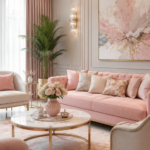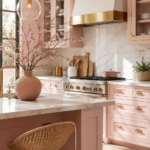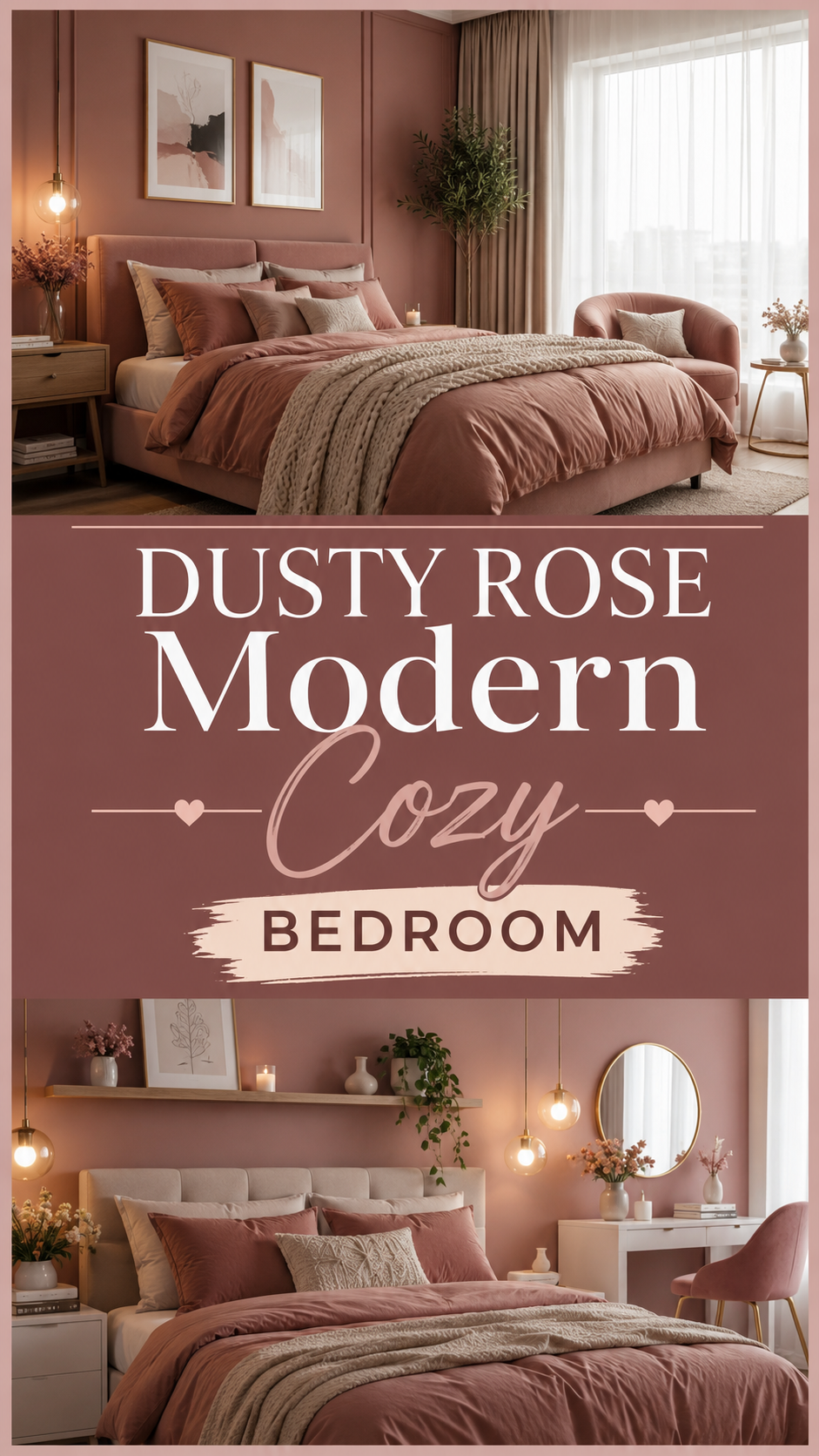
Dusty rose sits in that rare category of colors that reads as soft without tipping into sweet. Mixed with a touch of gray, it loses the candy-pink quality of a typical blush and gains something closer to weathered clay or faded velvet.
This guide covers how to build a modern, cozy bedroom around dusty rose, from wall treatments and furniture pairings down to the small styling details that separate a curated room from a themed one.
The color has staying power precisely because it refuses to commit fully to “pink.” Depending on the light and what sits next to it, dusty rose can lean toward mauve, terracotta, or even a soft taupe, which gives it far more flexibility than a true pastel pink would ever offer.
Bedrooms in particular reward this kind of restraint. A space meant for rest doesn’t need bold contrast or high-saturation color the way a living room or kitchen might. Dusty rose delivers personality at a volume that still lets the room feel calm at the end of a long day.
Why This Style Works
Dusty rose behaves like a neutral in disguise. It pairs with warm woods, cool grays, and deep greens without clashing, which is unusual for a color in the pink family and one reason designers keep returning to it season after season.
The muted undertone reads as mature rather than youthful. A saturated bubblegum pink signals a nursery or a teenager’s room, while dusty rose, with its added gray, signals intentional design choices made by an adult who knows what they want.
The color also does something useful with light. In north-facing rooms that tend to feel cool and flat, dusty rose adds warmth without the visual weight of a true red or a deep terracotta. In south-facing rooms with plenty of natural light, it softens harsh brightness instead of competing with it.
Cozy doesn’t have to mean cluttered or overly soft. Paired with structured modern furniture, dusty rose keeps a room feeling calm and grounded rather than fussy or overly romantic.
There’s also a practical case for longevity. Trend-driven colors tend to cycle out within a few years, but dusty rose has moved through multiple design eras, from its first wave of popularity decades ago through several recent revivals, without ever fully disappearing. A color with that track record is a safer long-term investment than something tied to a single viral moment.
Skin tones and personal photography also benefit from a dusty rose backdrop. Because the color sits close to natural undertones found in most skin, it flatters people photographed against it far more consistently than a stark white or a saturated jewel tone would.
Colour Palette Guide
The 60-30-10 rule works especially well with dusty rose because it prevents the color from overwhelming a room the way an accent wall of a bolder hue might.
| Proportion | Role | Suggested Colors |
|---|---|---|
| 60% | Dominant/background | Warm white, cream, or light greige walls |
| 30% | Secondary | Dusty rose bedding, curtains, or an accent wall |
| 10% | Accent | Charcoal, forest green, or brushed brass details |
Alternative palette for a moodier bedroom:
| Proportion | Role | Suggested Colors |
|---|---|---|
| 60% | Dominant | Dusty rose walls |
| 30% | Secondary | Warm white bedding and linens |
| 10% | Accent | Black or aged brass fixtures |
Dusty rose pairs particularly well with sage green, warm terracotta, soft navy, and champagne gold. It clashes most often with cool blue-based grays and bright white trim, which can make the pink look chalky rather than warm. <div class=”callout designer-note”> <strong>Designer Note:</strong> Test paint swatches at both morning and evening light before committing to a full wall. Dusty rose shifts noticeably under warm bulb light versus daylight, sometimes reading almost mauve after sunset. </div>
Furniture, Lighting, and Layout
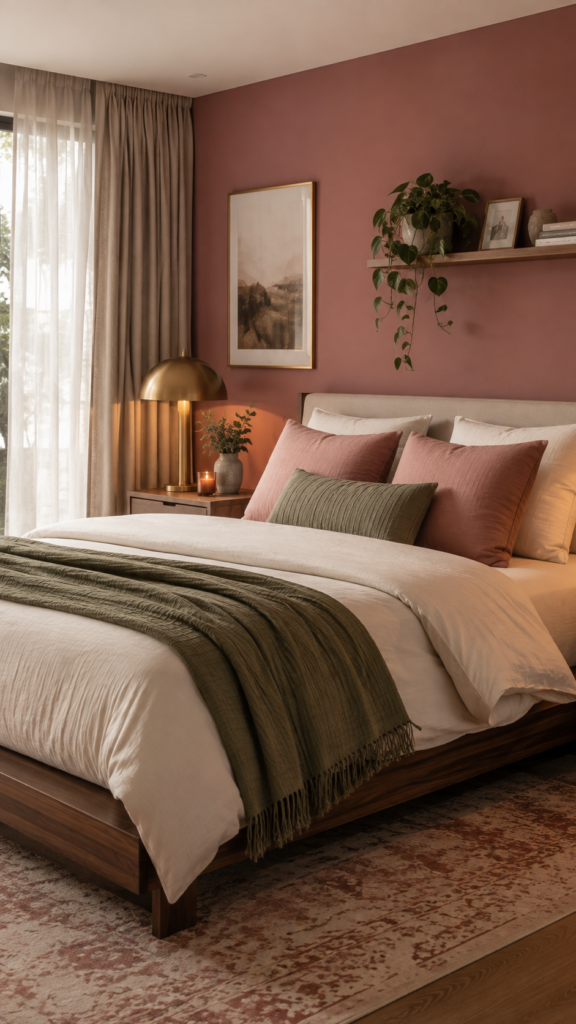
Furniture in this palette works best with clean, unfussy lines. A platform bed in walnut or white oak balances the softness of dusty rose textiles without adding competing ornamentation. Avoid heavily carved or ornate frames, which push the room toward traditional rather than modern.
Lighting should lean warm, never cool-toned. A 2700K bulb temperature flatters dusty rose far better than a bright white 4000K bulb, which can wash out the color’s warmth and make it look faded rather than intentional.
Layered lighting adds the cozy factor. A single overhead fixture rarely creates the right mood. Pair a dimmable overhead light with a bedside lamp and, where possible, a floor lamp in the reading corner for three distinct light sources at different heights.
Layout should keep the bed as the visual anchor. Position the headboard against the largest uninterrupted wall, and if using dusty rose as an accent wall color, apply it exclusively behind the headboard rather than around the entire room.
Nightstands should stay simple and low-profile. A pair of matching nightstands in warm wood keeps the eye focused on the bedding rather than competing furniture silhouettes. Reserve any ornate or statement pieces for a single accent chair or bench instead.
Rugs anchor the color scheme from the floor up. A rug in warm cream, soft taupe, or a muted terracotta pulls the room together without introducing a third competing pattern. Choose a rug large enough that at least the front two-thirds of the bed sits on it, which keeps the layout from feeling disconnected. <div class=”callout quick-win”> <strong>Quick Win:</strong> Swap a white or ivory lampshade for one in linen or dusty rose fabric. The warm glow through the shade tints the whole room subtly pink at night without any wall paint involved. </div>
Textile and Material Pairings
The fabrics chosen alongside dusty rose matter almost as much as the shade itself. Matte, slightly textured materials tend to flatter this color far better than anything glossy or synthetic-looking.
Linen and washed cotton soften the color and give it a lived-in, relaxed quality that suits a modern bedroom better than crisp, heavily starched fabric.
Boucle and mohair add tactile warmth, particularly useful on a headboard or accent chair, and their nubby texture keeps a soft color from reading as flat or one-note.
Velvet works best in small doses, such as a single throw pillow or a bench cushion, since a full velvet headboard in dusty rose can tip the room toward overly formal or dated rather than modern.
Natural wood and rattan ground the softness of the color scheme. A rattan bench, a wood-framed mirror, or woven baskets for storage all keep the room from feeling like it belongs entirely in one color family.
Metal accents should lean warm. Brushed brass, aged gold, and warm bronze all read as intentional next to dusty rose, while chrome or polished silver tend to look cold by comparison.
Small Space Adaptations
In small bedrooms, skip a full accent wall and instead use dusty rose in textiles only, such as a duvet cover, a pair of curtains, or a bench at the foot of the bed. This keeps the room feeling open rather than boxed in by a saturated color.
Studio apartments benefit from using dusty rose sparingly in a single zone, such as bedding and one nearby throw pillow, while keeping the rest of the space in warm neutrals to avoid the color spreading and overwhelming shared living areas.
Low-ceiling rooms should avoid dusty rose on the ceiling or upper walls, which visually lowers the room further. Keep the color at bed height and below, with lighter tones above eye level.
Rental-friendly options include removable wallpaper in a subtle dusty rose pattern, which delivers the color payoff without a repaint at move-out.
Budget vs. Luxury Comparison
| Element | Budget Approach | Luxury Approach |
|---|---|---|
| Wall treatment | Dusty rose paint, one accent wall | Grasscloth or plaster wall finish in dusty rose |
| Bedding | Cotton duvet set in dusty rose | Washed linen or silk-blend bedding |
| Lighting | Plug-in sconces or a single lamp | Layered dimmable fixtures with brass detailing |
| Furniture | Ready-to-assemble platform bed | Solid wood or upholstered bed frame |
| Textiles | Machine-washable throw and pillow covers | Mohair throw, hand-loomed area rug |
| Total cost (full room refresh) | $400–$800 | $2,500–$6,000+ |
A dusty rose duvet set and two coordinating throw pillows deliver most of the visual impact of a full room overhaul for a fraction of the cost, which makes textiles the smartest starting point for a budget refresh.
Styling Mistakes to Avoid
Pairing dusty rose with cool-toned white trim. The undertones clash and make the pink look dull. Warm white or cream trim reads far better against a rose wall.
Using dusty rose on every surface in the room. Walls, bedding, curtains, and rug all in the same tone flattens the space. Vary the shade slightly or introduce a contrasting neutral to add depth.
Choosing overly cool LED bulbs. This is one of the most common mistakes in a dusty rose bedroom and one of the easiest to fix, simply by swapping to a warmer bulb temperature.
Skipping a grounding dark accent. Without at least one deep tone, such as charcoal bedding trim or black hardware, an all-pink-and-white room can feel flat and overly sweet rather than sophisticated.
Forgetting texture variation. Smooth cotton, nubby boucle, and soft velvet all read differently even in the same color family. Relying on one fabric type across the whole room makes the space feel one-dimensional.
DIY Improvements
Reupholster a headboard in a dusty rose boucle or linen fabric using a staple gun and foam padding, a project that typically takes an afternoon and costs a fraction of buying new.
Dye plain white curtains using a fabric dye in a dusty rose shade, following the dye packet’s ratio for the fabric weight, then hang them unlined for soft, diffused morning light.
Paint furniture hardware in aged brass using a metallic spray paint formulated for metal, giving dated cabinet pulls or bed frame legs a warmer, more current finish.
Build a simple floating shelf in stained or whitewashed wood above the headboard for styled objects like a small vase, a framed print, or a taper candle holder. <div class=”callout maintenance-note”> <strong>Maintenance Note:</strong> Dusty rose fabrics, especially linen, can fade unevenly in direct sunlight. Rotate bedding and cushion covers seasonally, and use UV-filtering window film if the room gets strong afternoon sun. </div>
Style Variations
Modern minimalist: dusty rose limited to bedding only, paired with white oak furniture, black hardware, and a single piece of framed art.
Japandi-inspired: dusty rose textiles combined with low-profile wood furniture, woven baskets, and warm paper lantern-style lighting.
Glam cozy: dusty rose velvet headboard, brushed brass fixtures, a faux fur throw, and a statement mirror to bounce light around the room.
Boho warm: dusty rose layered with terracotta, rattan furniture, macrame wall hangings, and a mix of patterned textiles.
Scandinavian soft: dusty rose as a single accent wall behind the bed, paired with crisp white linens and pale wood furniture for a bright, airy feel.
Frequently Asked Questions
Does dusty rose work in a bedroom with limited natural light? Yes, particularly well. The muted pink adds warmth to a dim room without the heaviness of a darker color, and warm-toned lighting enhances this effect further.
What wood tones pair best with dusty rose? Warm woods like walnut, white oak, and honey oak complement dusty rose more naturally than cool-toned grey-washed wood, which can fight the pink’s warmth.
Is dusty rose a good choice for a shared adult bedroom? Yes. Because it reads as sophisticated rather than overtly feminine, especially when balanced with charcoal, black, or deep green accents, it works well as a gender-neutral palette for couples.
How do I keep a dusty rose room from feeling dated in a few years? Concentrate the color in easily swappable elements like bedding, curtains, and pillows rather than permanent surfaces like tile or built-in cabinetry, so the palette can evolve without a major renovation.
What’s the best accent color if I want to avoid an all-pink room? Sage green and charcoal are the two most reliable pairings, both providing enough contrast to ground the softness of dusty rose without clashing.
Can dusty rose work with patterned wallpaper instead of solid paint? Yes. A subtle botanical or textured wallpaper in a dusty rose colorway can add more visual interest than a flat wall, particularly behind a headboard where furniture will cover the lower portion of the pattern.
Should curtains match the wall color or contrast with it? A soft contrast usually works better than an exact match. Warm white or cream curtains against a dusty rose wall let the wall color stand out rather than blending into a single flat block of color.
A dusty rose bedroom doesn’t need much to feel finished. One good wall, warm lighting, and a handful of textiles in the right tone carry the whole room further than most people expect.