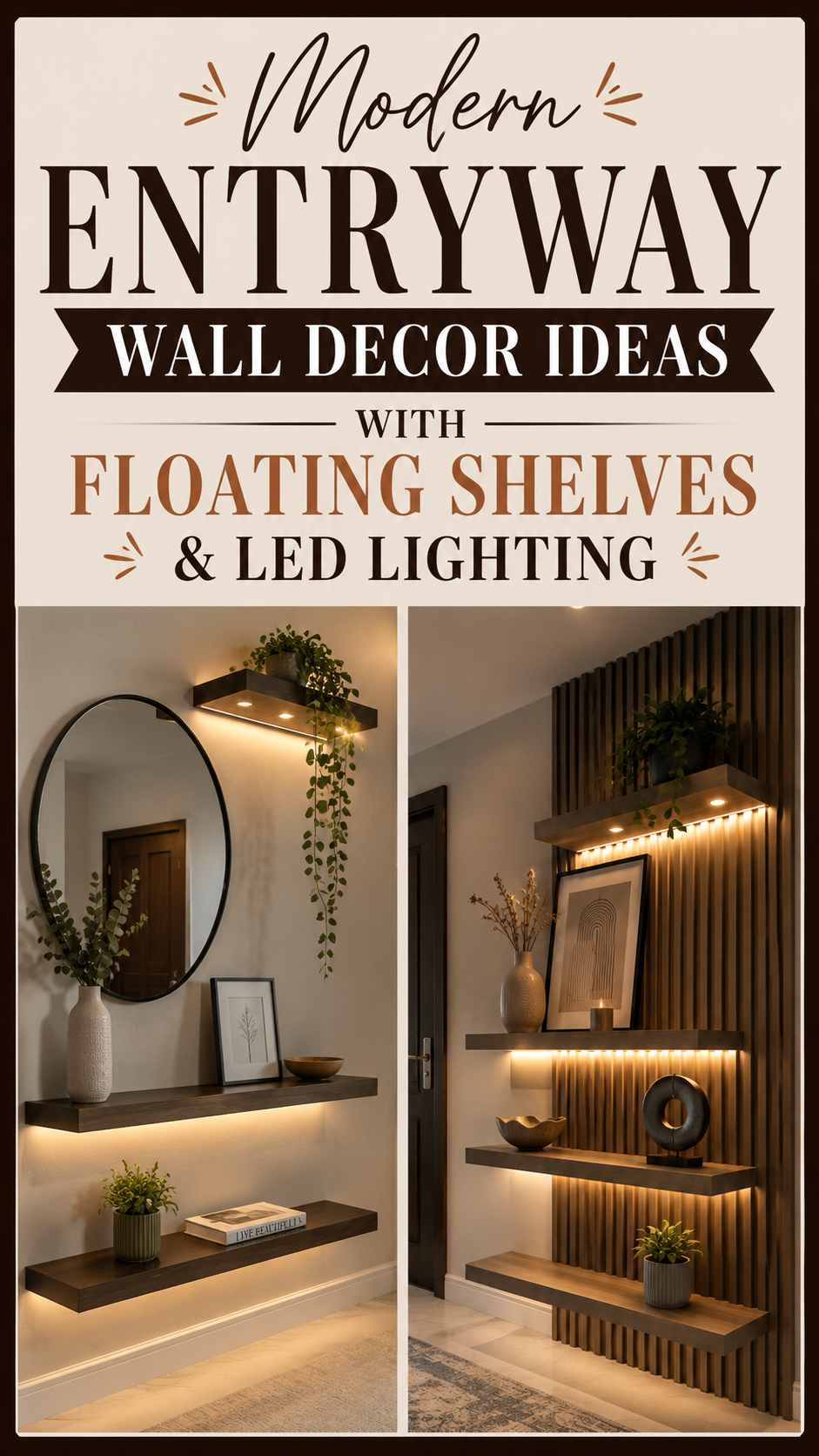
Your entryway gets judged in about three seconds. That’s roughly how long it takes a guest to form an opinion about your home, and a blank wall next to the front door wastes every one of those seconds.
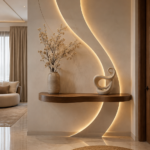
Floating shelves paired with LED lighting solve two problems at once. They give you a spot to display what matters, and they turn a dim hallway into something that actually glows on arrival.
This guide walks through how to plan, style, and light a modern entryway wall that looks like it belongs in a design magazine, not a rental unit.
Why Floating Shelves & LED Lighting Work So Well Together
Floating shelves read as architecture, not furniture. Because the brackets are hidden, the shelf appears to grow straight out of the wall. That illusion makes even a narrow entryway feel more considered and less cluttered than a console table ever could.
LED strips solve the number one entryway problem: bad lighting. Most hallways rely on a single overhead fixture that casts flat, unflattering light. A warm LED strip tucked under a shelf edge creates a soft glow that makes ceramics, framed art, and greenery look intentional instead of forgotten.
The combination works in almost any style. Japandi, modern farmhouse, minimalist, and even maximalist entryways all use floating shelves as a base layer, then adjust the objects and light temperature to match the mood.
Design Note: Warm white LEDs (2700K–3000K) suit entryways with wood tones and neutral palettes. Cooler white (4000K+) suits monochrome, industrial, or Scandinavian-leaning spaces.
Colour Palette Guide
A floating shelf wall lives or dies by contrast. The shelf, the wall behind it, and the objects on top need at least two levels of tonal separation, or the whole display flattens into visual noise.
The 60-30-10 entryway formula:
| Proportion | Element | Example |
|---|---|---|
| 60% | Wall colour (the base) | Warm white, greige, soft taupe |
| 30% | Shelf and larger objects | Walnut or oak shelf, ceramic vases |
| 10% | Accent pops | Black-framed art, brass hooks, dried florals |
Pairings that consistently photograph well:
- Warm minimalist: cream wall, light oak shelves, one black accent object
- Moody modern: charcoal or deep green wall, black or dark walnut shelf, brass or gold hardware
- Coastal Japandi: white-washed wall, pale ash shelf, woven baskets and linen textures
Keep the shelf finish and the largest piece of decor on it from competing. If the shelf is a statement colour, the objects on top should stay quiet.
Choosing & Placing Your Floating Shelves
Height matters more than most people think. Mount the lowest shelf at eye level for a seated glance, roughly 60–65 inches from the floor, then space additional shelves 10–14 inches apart so each tier stays visually distinct.
Depth should match function. A 6-inch shelf works for framed photos and candles. A 9–10 inch shelf is deep enough for a small lamp, a stack of books, or a wider ceramic bowl.
Length depends on wall width, not wall height. A single long shelf (36–48 inches) tends to look more architectural than two short shelves stacked close together, especially above a bench or shoe storage unit.
Quick Win: Stagger two shelves of different lengths at slightly offset heights instead of mounting them perfectly parallel. It breaks the rigid symmetry that makes a lot of entryway shelving feel like a hotel display.
Layout Tips for Styling the Shelf Itself
- Group in odd numbers. Three or five objects per shelf reads more natural than an even count.
- Vary height, not just width. Combine one tall item (vase, small branch arrangement), one medium item (framed art propped against the wall), and one low item (a dish for keys or a small stack of books).
- Leave negative space. A shelf packed edge to edge looks cluttered under LED light, since the glow highlights every object equally. Aim to fill roughly 70% of the surface.
Working LED Lighting Into the Design
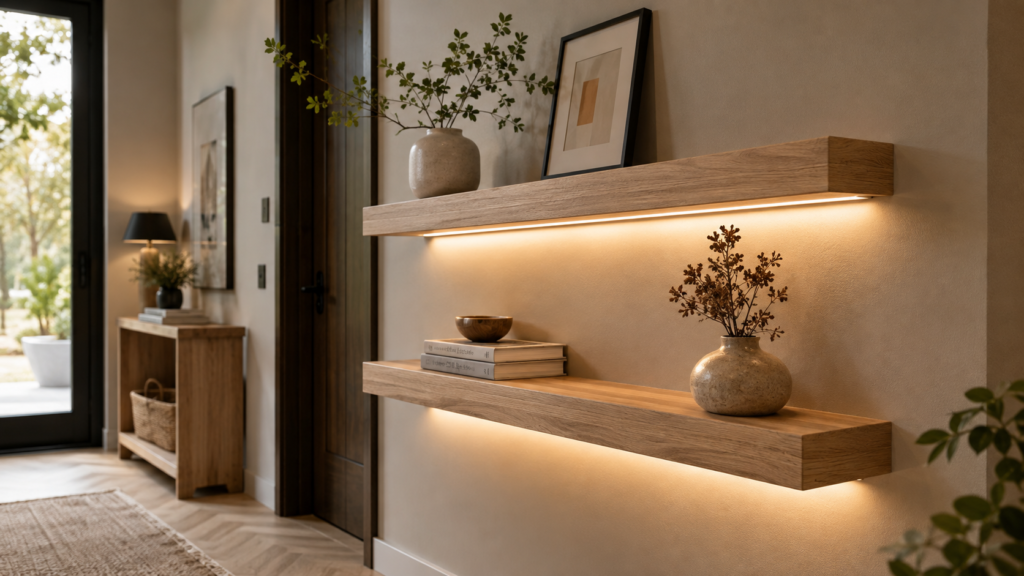
Under-shelf strips are the most common approach and the easiest to install. Peel-and-stick LED strips tuck into the front lip or underside of the shelf and wash light downward onto the wall or upward onto displayed objects.
Puck lights work well for shelves holding a single hero object, like a large vase or sculptural piece, since they create a focused spotlight rather than a wash.
Colour temperature and brightness:
| Setting | Best For | Notes |
|---|---|---|
| 2700K warm white | Wood tones, neutral palettes | Cozy, residential feel |
| 3000K soft white | Mixed metal and wood finishes | Balanced, versatile |
| 4000K cool white | Monochrome, industrial styles | Crisper, more retail-like |
| RGB/colour-changing | Playrooms, statement walls | Fun but reads less “designer” |
Maintenance Note: Dust LED strips and shelf surfaces every two to three weeks with a dry microfiber cloth. Built-up dust dims LED output over time and is one of the most common reasons a lit shelf starts looking flat after a few months.
Small Entryway Adaptations
Narrow hallways and apartment entries need a scaled-down version of this same idea.
- Go single-shelf. One well-styled shelf beats two crowded ones in a tight space.
- Choose a shallow depth. A 4–5 inch shelf keeps the walkway clear while still holding candles, small frames, or a slim vase.
- Skip the console entirely. In a true pinch-point entryway, a floating shelf with a hook rail underneath replaces the need for a table altogether.
- Use vertical LED accents. A slim vertical strip beside a mirror can add glow without needing shelf-mounted lighting at all.
Budget vs. Luxury Comparison
| Element | Budget Approach | Luxury Approach |
|---|---|---|
| Shelf material | MDF with wood veneer | Solid oak or walnut, live-edge |
| Brackets | Standard hidden bracket kit | Custom-fabricated steel or brass bracket |
| LED lighting | Basic peel-and-stick strip, plug-in | Hardwired strip with dimmer and smart control |
| Styling objects | Thrifted ceramics, faux greenery | Hand-thrown pottery, dried botanical arrangements |
| Mirror pairing | Framed mirror from a big-box retailer | Custom-shaped or antiqued mirror |
| Total per shelf setup | $60–$150 | $400–$900+ |
A budget shelf styled with intention and good lighting will consistently outperform an expensive shelf styled carelessly. Lighting quality and object curation matter more than material cost.
Styling Mistakes to Avoid
- Mounting shelves too high. If you have to look up to see the display, it disconnects from the rest of the entryway.
- Using cool, harsh LED light in a warm-toned space. Mismatched colour temperature is one of the fastest ways to make a styled shelf look like a store display instead of a home.
- Overcrowding the surface. Every object needs breathing room, especially once the LED strip is turned on and drawing the eye.
- Ignoring wall colour behind the shelf. A white shelf on a white wall disappears; add contrast through paint, wallpaper, or a mirror.
- Forgetting cord management. Visible cords running down the wall undercut the clean look a floating shelf is meant to create. Route cords behind the shelf or use battery-powered strips.
DIY Improvements
- Paint a contrast strip behind the shelf. A soft accent block in a slightly darker or bolder shade instantly makes the shelf feel built-in.
- Add a peel-and-stick LED kit. Most kits include a remote and require no wiring knowledge, making this the easiest weekend upgrade on this list.
- Build a simple picture ledge. A picture-ledge style floating shelf is one of the easiest beginner woodworking projects and doubles as an art rail.
- Swap hardware for brass or matte black. Changing brackets or hooks is a low-cost way to shift the entire mood of the shelf without replacing anything structural.
Style Variations
Modern Minimalist: single long oak shelf, warm white LED strip, three ceramic objects, no visible hardware.
Moody Maximalist: dark painted wall, two staggered black shelves, layered art and dried florals, warm LED glow with a dimmer.
Japandi Entryway: pale wood shelf, woven basket, single branch arrangement, soft under-shelf light at low brightness.
Industrial Loft: black metal bracket shelf, exposed LED strip in a metal channel, mixed metal objects and a large round mirror.
FAQ
Do floating shelves need to be professionally installed? Most floating shelves come with a wall-mounted bracket system that’s manageable as a DIY project with a stud finder and level. Heavier shelves or plaster walls may benefit from professional anchoring.
Will LED strips damage my paint when removed? Quality peel-and-stick strips rated for interior walls generally remove cleanly from cured paint. Testing a small hidden section first is a smart precaution on darker or matte finishes.
How many shelves is too many for one entryway wall? Two to three shelves is the sweet spot for most entryways. Beyond that, the wall starts to compete with the rest of the space rather than complementing it.
Can I add LED lighting to shelves I already own? Yes. Peel-and-stick or clip-on LED strips can be retrofitted to almost any existing shelf, provided there’s a nearby outlet or the strip is battery or USB powered.
What’s the best shelf depth for a small entryway? Four to six inches keeps the walkway clear while still allowing room for candles, small frames, or a slim vase arrangement.
A floating shelf with the right light does more for an entryway than most furniture pieces twice its size.